
|
You entered: sky
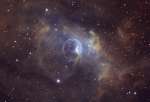 The Bubble Nebula
2.09.2010
Blown by the wind from a massive star, this interstellar apparition has a surprisingly familiar shape. Cataloged as NGC 7635, it is also known simply as The Bubble Nebula. Although it looks delicate, the 10 light-year diameter bubble offers evidence of violent processes at work.
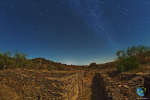 Draconid Meteors Over Spain
19.10.2011
What are those streaks in the sky? They're meteors from the Draconids meteor shower that peaked earlier this month. The above composite image captured numerous meteor streaks over 90 minutes above the Celtic ruins of Capote in Badajoz province, Spain.
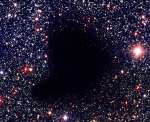 Molecular Cloud Barnard 68
29.01.2012
Where did all the stars go? What used to be considered a hole in the sky is now known to astronomers as a dark molecular cloud. Here, a high concentration of dust and molecular gas absorb practically all the visible light emitted from background stars.
 Bright Jupiter in Taurus
27.11.2012
That bright star you've recently noticed rising just after sunset isn't a star at all. It's Jupiter, the solar system's ruling gas giant. Bright Jupiter is nearing its December 3rd opposition when it will stand in Taurus, opposite the Sun in planet Earth's sky.
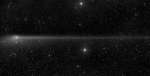 PanSTARRS Anti Tail Grows
26.05.2013
As planet Earth approached the plane of the Comet PanSTARRS (C/2011 L4) orbit on May 23rd, comet watchers were treated to this view of its magnificent anti-tail. The long, narrow anti-tail stretches to the right across this frame for nearly 4 degrees or about 8 times the angular size of the full Moon.
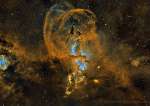 Star Forming Region NGC 3582
11.06.2013
What's happening in the NGC 3582 nebula? Bright stars and interesting molecules are forming. The complex nebula resides in the star forming region called RCW 57. Visible in this image are dense knots...
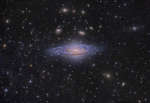 NGC 7331 and Beyond
17.12.2014
Big, beautiful spiral galaxy NGC 7331 is often touted as an analog to our own Milky Way. About 50 million light-years distant in the northern constellation Pegasus, NGC 7331 was recognized early on as a spiral nebula and is actually one of the brighter galaxies not included in Charles Messier's famous 18th century catalog.
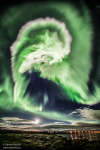 A Spiral Aurora over Iceland
15.09.2015
What's happened to the sky? Aurora! Captured late last month, this aurora was noted by Icelanders for its great brightness and quick development. The aurora resulted from a solar storm, with high energy particles bursting out from the Sun and through a crack in Earth's protective magnetosphere a few days later.
 Valles Marineris: The Grand Canyon of Mars
29.05.2016
Mars will look good in Earth's skies over the next few days -- but not this good. To get a view this amazing, a spacecraft had to actually visit the red planet. Running across the image center, though, is one the largest canyons in the Solar System.
 Detailed View of a Solar Eclipse Corona
13.08.2017
Only in the fleeting darkness of a total solar eclipse is the light of the solar corona easily visible. Normally overwhelmed by the bright solar disk, the expansive corona, the sun's outer atmosphere, is an alluring sight.
|
January February March April May June July August September October |
|||||||||||||||||||||||||||||||||||||||||||||||||