
|
You entered: sky
 A Space Station Crosses a Busy Sun
11.04.2022
Typically, the International Space Station is visible only at night. Slowly drifting across the night sky as it orbits the Earth, the International Space Station (ISS) can be seen as a bright spot several times a year from many locations.
 APOD: 2023 September 24 Б A Ring of Fire Sunrise Solar Eclipse
24.09.2023
What's rising above the horizon behind those clouds? It's the Sun. Most sunrises don't look like this, though, because most sunrises don't include the Moon. In the early morning of 2013 May 10, however, from Western Australia, the Moon was between the Earth and the rising Sun.
 APOD: 2023 December 27 Б Rainbow Aurora over Icelandic Waterfall
27.12.2023
Yes, but can your aurora do this? First, yes, auroras can look like rainbows even though they are completely different phenomena. Auroras are caused by Sun-created particles being channeled into Earth's atmosphere by Earth's magnetic field, and create colors by exciting atoms at different heights.
 APOD: 2024 September 10 Б Horsehead and Orion Nebulas
10.09.2024
The dark Horsehead Nebula and the glowing Orion Nebula are contrasting cosmic vistas. Adrift 1,500 light-years away in one of the night sky's most recognizable constellations, they appear in opposite corners of the above stunning mosaic.
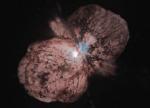 Doomed Star Eta Carinae
13.08.2000
Eta Carinae may be about to explode. But no one knows when - it may be next year, it may be one million years from now. Eta Carinae's mass - about 100 times greater than our Sun - makes it an excellent candidate for a full blown su
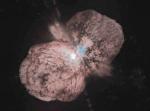 Doomed Star Eta Carinae
28.04.2002
Eta Carinae may be about to explode. But no one knows when - it may be next year, it may be one million years from now. Eta Carinae's mass - about 100 times greater than our Sun - makes it an excellent candidate for a full blown supernova.
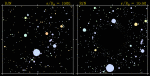 Too Close to a Black Hole
27.11.1995
What would you see if you went right up to a black hole? Above are two computer generated pictures highlighting how strange things would look. On the left is a normal star field containing the constellation Orion. Notice the three stars of nearly equal brightness that make up Orion's Belt.
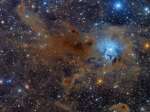 NGC 7023: The Iris Nebula
6.05.2016
These cosmic clouds have blossomed 1,300 light-years away, in the fertile starfields of the constellation Cepheus. Called the Iris Nebula, NGC 7023 is not the only nebula to evoke the imagery of flowers, though.
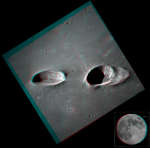 Messier Craters in Stereo
2.12.2017
Many bright nebulae and star clusters in planet Earth's sky are associated with the name of astronomer Charles Messier, from his famous 18th century catalog. His name is also given to these two large and remarkable craters on the Moon.
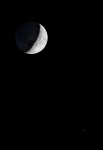 Jupiter and the Moons
5.10.2019
After sunset on October 3, some of the Solar System's largest moons stood low along the western horizon with the largest planet. Just after nightfall, a pairing of the Moon approaching first quarter phase and Jupiter was captured in this telephoto field of view.
|
January February March April May June July August September October |
|||||||||||||||||||||||||||||||||||||||||||||||||