
|
You entered: image
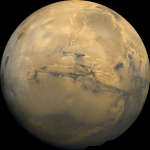 Valles Marineris: The Grand Canyon of Mars
11.05.2014
The largest canyon in the Solar System cuts a wide swath across the face of Mars. Named Valles Marineris, the grand valley extends over 3,000 kilometers long, spans as much as 600 kilometers across, and delves as much as 8 kilometers deep.
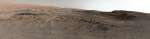 Curiosity s View
8.08.2015
By planet Earth's calendar, the Curiosity Mars Rover reached its 3rd anniversary on the surface of the Red Planet on August 6. To celebrate, gaze across this dramatic panoramic view of diverse terrain typical of the rover's journey to the layered slopes of Aeolis Mons, also known as Mount Sharp.
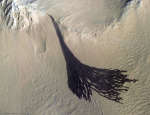 Dark Slope Streaks Split on Mars
18.07.2018
What is creating these dark streaks on Mars? No one is sure. Candidates include dust avalanches, evaporating dry ice sleds, and liquid water flows. What is clear is that the streaks occur through light surface dust and expose a deeper dark layer.
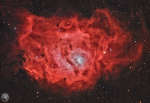 The Lagoon Nebula is Stars, Gas, and Dust
12.11.2018
The majestic Lagoon Nebula is filled with hot gas and the home for many young stars. Spanning 100 light years across while lying only about 5000 light years distant, the Lagoon Nebula is so big and bright that it can be seen without a telescope toward the constellation of the Archer (Sagittarius).
 Shadow of a Martian Robot
17.02.2019
What if you saw your shadow on Mars and it wasn't human? Then you might be the Opportunity rover currently exploring Mars. Opportunity explored the red planet from 2004 to 2018, finding evidence of ancient water, and sending breathtaking images across the inner Solar System.
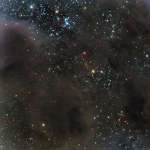 Chamaeleon II Dark Cloud
2.08.2019
A small constellation hiding near the south celestial pole, The Chamaeleon boasts no bright stars. Stars are forming within its constellation boundaries though, in a complex of dark, dusty molecular clouds. Some 500 light-years...
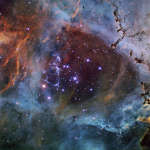 NGC 2244: A Star Cluster in the Rosette Nebula
21.02.2021
In the heart of the Rosette Nebula lies a bright open cluster of stars that lights up the nebula. The stars of NGC 2244 formed from the surrounding gas only a few million years ago.
 Planet Line over New York Bridge
20.04.2022
There's an interesting sky to see if you wake up before the Sun. Lined up on toward the eastern horizon are four planets in a row. The planets are so bright they can even be seen from the bright sky inside a city.
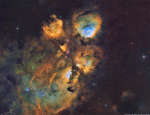 NGC 6334: The Cats Paw Nebula
10.05.2022
Nebulas are perhaps as famous for being identified with familiar shapes as perhaps cats are for getting into trouble. Still, no known cat could have created the vast Cat's Paw Nebula visible toward the constellation of the Scorpion (Scorpius.
 The Fornax Cluster of Galaxies
2.11.2023
Named for the southern constellation toward which most of its galaxies can be found, the Fornax Cluster is one of the closest clusters of galaxies. About 62 million light-years away, it's over...
|
January February March April May June July August September |
|||||||||||||||||||||||||||||||||||||||||||||||||