
|
You entered: image
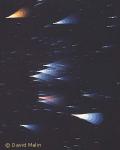 Orion Star Colours
29.08.1998
What determines a star's colour? Its temperature. Red stars are cool, around 3,000 kelvins (K), while blue stars are hotter and can have temperatures over 30,000 K. Our own lovely yellow Sun's temperature is a comforting 6,000 K.
 Attacking Mars
19.07.2004
The Spirit rover attacked Mars again late last month. What might look, above, like a military attack, though, was once again just a scientific one - Spirit was instructed to closely inspect some interesting rocks near Columbia Hills.
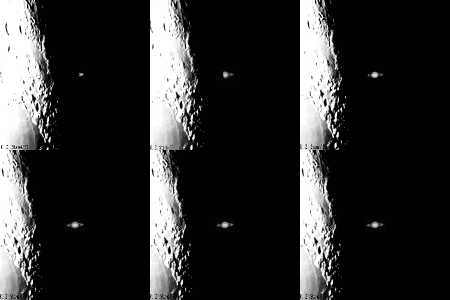 Moon Occults Saturn
8.05.1999
On September 18, 1997, many stargazers in the U. S. were able to watch a lovely early morning lunar occultation as a bright Moon passed in front of Saturn. Using a 1.2 meter reflector, astronomer Kris Stanek had an excellent view of this dream-like event from the Whipple Observatory atop Arizona's Mount Hopkins.
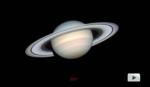 Four Years of Saturn
6.04.2007
Saturn and its magnificent ring system can offer even casual astronomers the most memorable of telescopic sights. Wandering between Leo and Cancer this month, a bright Saturn is well placed for viewing in evening skies. But from our earthbound perspective, the tilt of Saturn's rings does change with time.
 Aurora Persei
9.08.2008
Dark skies are favored for viewing meteor showers -- so the best viewing of this year's Perseids will occur in the early morning. While the Perseid meteor shower is scheduled to peak over...
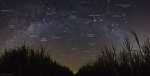 A Starry Night in Brazil
9.05.2009
This panoramic image tracing constellations in the southern sky shows off a beautiful vista toward the center of our Milky Way Galaxy. It was recorded just last month near the city of Campos in northeastern Rio de Janeiro state, Brazil.
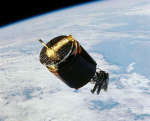 The Astronaut Who Captured a Satellite
11.01.2010
In 1984, high above the Earth's surface, an astronaut captured a satellite. It was the second satellite captured that mission. Pictured above, astronaut Dale A. Gardner flies free using the Manned Maneuvering Unit and begins to attach a control device dubbed the Stinger to the rotating Westar 6 satellite.
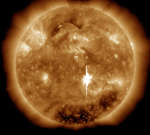 X Class Flare
17.02.2011
On Valentine's Day (ET) the Sun unleased one of its most powerful explosions, an X-class flare. The blast was the largest so far in the new solar cycle. Erupting from active region AR1158...
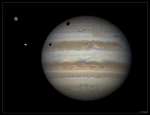 Shadows Across Jupiter
15.02.2013
Two dark shadows loom across the banded and mottled cloud tops of Jupiter in this sharp telescopic view. In fact, captured on January 3rd, about a month after the ruling gas giant appeared at opposition in planet Earth's sky, the scene includes the shadow casters.
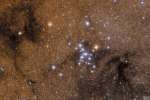 M7: Open Star Cluster in Scorpius
7.01.2014
M7 is one of the most prominent open clusters of stars on the sky. The cluster, dominated by bright blue stars, can be seen with the naked eye in a dark sky in the tail of the constellation of the Scorpion (Scorpius).
|
January February March April May June July August September |
|||||||||||||||||||||||||||||||||||||||||||||||||