
|
You entered: image
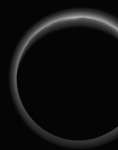 Pluto at Night
26.03.2022
The night side of Pluto spans this shadowy scene. In the stunning spacebased perspective the Sun is 4.9 billion kilometers (almost 4.5 light-hours) behind the dim and distant world. It was captured...
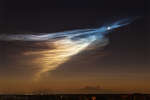 APOD: 2024 July 9 Б Noctilucent Clouds over Florida
9.07.2024
These clouds are doubly unusual. First, they are rare noctilucent clouds, meaning that they are visible at night -- but only just before sunrise or just after sunset. Second, the source of these noctilucent clouds is actually known.
 Pluto at Night
16.11.2024
The night side of Pluto spans this shadowy scene. In the stunning spacebased perspective the Sun is 4.9 billion kilometers (almost 4.5 light-hours) behind the dim and distant world. It was captured...
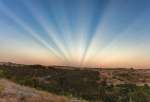 Anticrepuscular Rays over Sicily
25.06.2026
The Sun has just set... in the opposite side of the sky. Pictured here are anticrepuscular rays apparently converging in the east in this image of the limestone plateau in the heart of the Hyblaean Mountains of southeastern Sicily, in Italy. How were these anticrepuscular rays formed, if the Sun wasn't there?
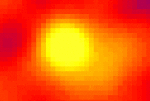 GRB970228: What's There?
7.04.1997
Could this fuzzy blob be the key to the whole gamma-ray burst (GRB) mystery? Astronomers the world over are now scrambling to determine the true nature of the extended emission seen to the lower right of the bright source in the above image.
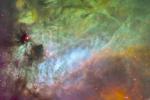 Elements of the Swan Nebula
11.08.2003
In the depths of the dark clouds of dust and molecular gas known as M17, stars continue to form. Also known as the Omega Nebula and Horseshoe Nebula, the darkness of M17's molecular clouds results from background starlight being absorbed by thick filaments of carbon-based smoke-sized dust.
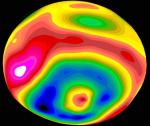 A Map of Asteroid Vesta
8.09.1997
Vesta is a huge rock 500 kilometers across that orbits out past Mars. Last week, the above map of Vesta created using the Hubble Space Telescope was released showing a rugged surface highlighted by a single crater spanning nearly the entire length of the asteroid.
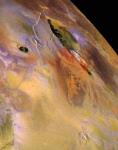 Zal Patera on Jupiter's Moon Io
7.03.2000
The Galileo orbiter's flyby of Io last November captured an unusual part of Jupiter's volcanic moon. From 26,000 kilometers away, Zal Patera was found to be a cauldron of flowing lava, gaseous vents, and tremendous peaks.
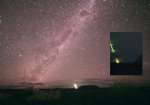 Fireball at Ayers Rock
28.06.2008
A weekend trip for astrophotography in central Australia can result in gorgeous skyscapes. In this example recorded in March of 2006, the center of our Milky Way Galaxy rises over planet Earth's horizon and the large sandstone formation called Uluru, also known as Ayers Rock.
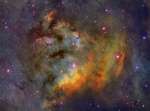 Sharpless 171
18.10.2008
Cosmic pillars of cold molecular gas and clouds of dark dust lie within Sharpless 171, a star-forming region some 3,000 light-years away in the royal constellation Cepheus. This tantalizing false-color skyscape spans about 20 light-years across the nebula's bright central region.
|
January February March April May June July August September |
|||||||||||||||||||||||||||||||||||||||||||||||||