
|
You entered: image
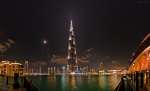 Starry Night over Dubai
16.07.2011
A starry night over the city of Dubai in the United Arab Emirates is really not so starry. In fact, the Moon is the only celestial beacon to come close to competing with city lights in this night skyscape, a situation all too familiar to urban skygazers.
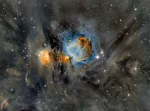 Orion Nebula in Surrounding Dust
25.03.2014
What surrounds a hotbed of star formation? In the case of the Orion Nebula -- dust. The entire Orion field, located about 1600 light years away, is inundated with intricate and picturesque filaments of dust.
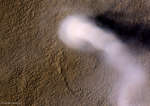 A Dust Devil on Mars
2.03.2015
It was late in the northern martian spring when the HiRISE camera onboard the Mars Reconnaissance Orbiter spied this local denizen. Tracking across the flat, dust-covered Amazonis Planitia in 2012, the core of this whirling dust devil is about 140 meters in diameter.
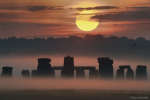 Sunrise Solstice over Stonehenge
20.06.2016
Today the Sun reaches its northernmost point in planet Earth's sky. Called a solstice, the date traditionally marks a change of seasons -- from spring to summer in Earth's Northern Hemisphere and from fall to winter in Earth's Southern Hemisphere.
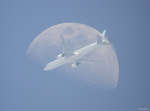 An Airplane in Front of the Moon
3.07.2018
If you look closely at the Moon, you will see a large airplane in front of it. Well, not always. OK, hardly ever. Actually, to capture an image like this takes precise timing...
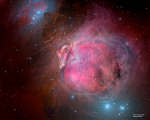 The Great Turkey Nebula
26.11.2020
Surprisingly reminiscent of The Great Nebula in Orion, The Great Turkey Nebula spans this creative field of view. Of course if it were the Orion Nebula it would be our closest large stellar nursery, found at the edge of a large molecular cloud a mere 1,500 light-years away.
 APOD: 2025 September 2 Б The Horsehead and Flame Nebulas
2.09.2025
The Horsehead Nebula is one of the most famous nebulae on the sky. It is visible as the dark indentation to the orange emission nebula at the far right of the featured picture. The horse-head feature is dark because it is really an opaque dust cloud that lies in front of the bright emission nebula.
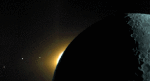 The Ecliptic Plane
14.10.2000
The Plane of the Ecliptic is well illustrated in this picture from the 1994 lunar prospecting Clementine spacecraft. Clementine's star tracker camera image reveals (from right to left) the Moon lit by Earthshine, the Sun's corona rising over the Moon's dark limb, and the planets Saturn, Mars, and Mercury.
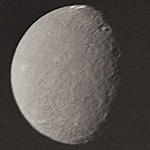 Uranus's Moon Umbriel: A Mysterious Dark World
7.04.1996
Why is Umbriel so dark? This dark moon reflects only half the light of other Uranus' moons such as Ariel. And what is that bright ring at the top? Unfortunately, nobody yet knows. These questions presented themselves when Voyager 2 passed this satellite of Uranus in January 1986.
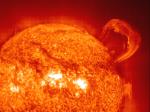 A Solar Prominence from SOHO
16.04.2006
How can gas float above the Sun? Twisted magnetic fields arching from the solar surface can trap ionized gas, suspending it in huge looping structures. These majestic plasma arches are seen as prominences above the solar limb.
|
January February March April May June July August September |
|||||||||||||||||||||||||||||||||||||||||||||||||