
|
You entered: image
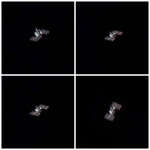 ISS from Wallasey
6.04.2019
After sunset on March 28, the International Space Station climbed above the western horizon, as seen from Wallasey, England at the mouth of the River Mersey. Still glinting in the sunlight some 400 kilometers...
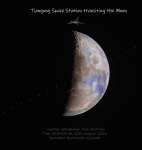 Tiangong Space Station Transits the Moon
25.08.2022
The rugged lunar south polar region lies at the top of this colorful portrait of a last quarter Moon made on August 20. Constructed from video frames and still images taken at Springrange, New South Wales, Australia it also captures a transit of China's Tiangong Space Station.
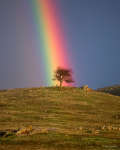 APOD: 2023 March 13 Б Rainbow Tree
13.03.2023
What lies at the end of a rainbow? Something different for everyone. For the photographer taking this picture, for example, one end of the rainbow ended at a tree. Others nearby, though, would likely see the rainbow end somewhere else. The reason is because a rainbow's position depends on the observer.
 Star Factory Messier 17
8.09.2023
Sculpted by stellar winds and radiation, the star factory known as Messier 17 lies some 5,500 light-years away in the nebula-rich constellation Sagittarius. At that distance, this 1/3 degree wide field of view spans over 30 light-years.
 APOD: 2024 December 2 Б NGC 300: A Galaxy of Stars
2.12.2024
This galaxy is unusual for how many stars it seems that you can see. Stars are so abundantly evident in this deep exposure of the spiral galaxy NGC 300 because so many of these stars are bright blue and grouped into resolvable bright star clusters.
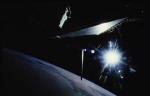 The Equal Night
23.09.2000
Yesterday the Sun crossed the celestial equator heading south, marking the Equinox -- the first day of Autumn in the northern hemisphere and Spring in the south. Equinox means equal night and with the Sun on the celestial equator, Earthlings will experience 12 hours of daylight and 12 hours of darkness.
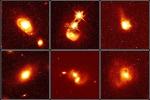 A Quasar Portrait Gallery
6.12.1997
QUASARs (QUASi-stellAR objects) lie near the edge of the observable Universe. Discovered in 1963, astronomers were astounded that such objects could be visible across billions of light-years, as this implies they must emit prodigious amounts of energy. Where does the energy come from?
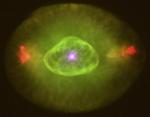 NGC 6826: The Blinking Eye
26.05.2001
The colorful planetary nebula phase of a sun-like star's life is brief. Almost in the "blink of an eye" - cosmically speaking - the star's outer layers are cast off, forming an expanding emission nebula. This nebula lasts perhaps 10 thousand years compared to a 10 billion year stellar life span.
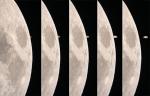 Saturn at the Lunar Limb
22.02.2002
Gliding through the sky on Wednesday evening, February 20th, a first quarter Moon seemed to run over bright planet Saturn as viewed from much of North America. In this sharp sequence of telescopic digital...
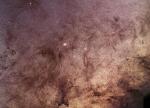 Stars and Dust Through Baades Window
23.12.2002
Billions of stars light up the direction toward the center of our Galaxy. The vast majority of these stars are themselves billions of years old, rivaling their home Milky Way Galaxy in raw age. These stars are much more faint and red than the occasional young blue stars that light up most galaxies.
|
January February March April May June July August September |
|||||||||||||||||||||||||||||||||||||||||||||||||