
|
You entered: Orion
 Too Close to a Black Hole
10.12.2000
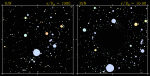
What would you see if you went right up to a black hole? Above are two computer generated images highlighting how strange things would look. On the left is a normal star field containing the constellation Orion. Notice the three stars of nearly equal brightness that make up Orion's Belt.
 NGC 1499: The California Nebula
22.10.2022
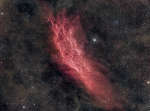
Drifting through the Orion Arm of the spiral Milky Way Galaxy, this cosmic cloud by chance echoes the outline of California on the west coast of the United States. Our own Sun also lies within the Milky Way's Orion Arm, only about 1,500 light-years from the California Nebula.
 Arcs, Jets, and Shocks near NGC 1999
7.03.2018
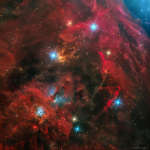
This tantalizing array of nebulas and stars can be found about two degrees south of the famous star-forming Orion Nebula. The region abounds with energetic young stars producing jets and outflows that push through the surrounding material at speeds of hundreds of kilometers per second.
 Barnard Stares at NGC 2170
19.01.2013
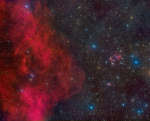
A gaze across a cosmic skyscape, this telescopic mosaic reveals the continuous beauty of things that are. The evocative scene spans some 6 degrees or 12 Full Moons in planet Earth's sky. At the left, folds of red, glowing gas are a small part of an immense, 300 light-year wide arc.
 Too Close to a Black Hole
27.11.1995
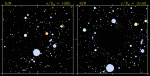
What would you see if you went right up to a black hole? Above are two computer generated pictures highlighting how strange things would look. On the left is a normal star field containing the constellation Orion. Notice the three stars of nearly equal brightness that make up Orion's Belt.
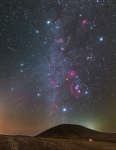 Orionids Meteors over Inner Mongolia
30.10.2018
Meteors have been shooting out from the constellation of Orion. This was expected, as October is the time of year for the Orionids Meteor Shower. Pictured here, over two dozen meteors were caught in successively added exposures last October over Wulan Hada volcano in Inner Mongolia, China.
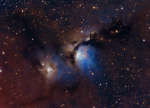 Stardust and Starlight in M78
8.03.2019
Interstellar dust clouds and bright nebulae abound in the fertile constellation of Orion. One of the brightest, M78, is near the center in this colorful telescopic view, covering an area north of Orion's belt. At a distance of about 1,500 light-years, the bluish nebula itself is about 5 light-years across.
 Aurora Australis and the International Space Station
13.09.2024
This snapshot from the International Space Station was taken on August 11 while orbiting about 430 kilometers above the Indian Ocean, Southern Hemisphere, planet Earth. The spectacular view looks south and east, down toward the planet's horizon and through red and green curtains of aurora australis.
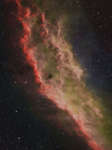 NGC 1499: The California Nebula
2.03.2011
What's California doing in space? Drifting through the Orion Arm of the spiral Milky Way Galaxy, this cosmic cloud by chance echoes the outline of California on the west coast of the United States.
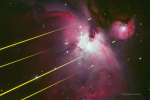 Nebula with Laser Beams
29.03.2017
Four laser beams cut across this startling image of the Orion Nebula, as seen from ESO's Paranal Observatory in the Atacama desert on planet Earth. Not part of an interstellar conflict, the lasers...
|
January February March April May June July August September |
|||||||||||||||||||||||||||||||||||||||||||||||||