
|
You entered: Orion
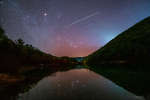 The Geminid
16.12.2022
Returning from beyond the Moon, on December 11 the Orion spacecraft entered Earth's atmosphere at almost 11 kilometers per second. That's half the speed of the grain of dust that created this long fireball meteor when it entered the atmosphere on December 13, near the peak of the annual Geminid meteor shower.
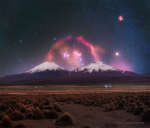 APOD: 2026 July 28 Б Barnards Loop over Twin Volcanoes
28.07.2026
What's connecting these two volcanoes? In ancient folklore, the two volcanoes, Parinacota (left) and Pomerape (right), are connected by representing a mythical prince and princess who engaged in a forbidden romance. Beneath...
 Venus by the Lake
14.04.2007
Finding Venus in the night sky is not too hard these days. Now appearing as the evening star, Venus rules as the brightest celestial beacon in west just after sunset. And if you can find Venus tonight, you can also easily find the lovely Pleiades star cluster (aka M45) close by.
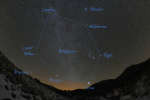 Winter Hexagon Over Stagecoach Colorado
3.01.2011
If you can find Orion, you might be able to find the Winter Hexagon. The Winter Hexagon involves some of the brightest stars visible, together forming a large and easily found pattern in the winter sky of Earth's northern hemisphere.
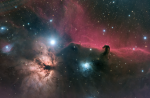 Horsehead and Flame
29.12.2022
The Horsehead Nebula, famous celestial dark marking also known as Barnard 33, is notched against a background glow of emission nebulae in this sharp cosmic skyscape. About five light-years "tall" the Horsehead lies some 1,500 light-years away in the constellation of Orion.
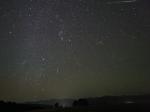 Orionid Meteors Over Turkey
23.10.2006
Meteors have been flowing out from the constellation Orion. This was expected, as mid-October is the time of year for the Orionids Meteor Shower. Pictured above, over a dozen meteors were caught in successively added exposures over three hours taken this past weekend from a town near Bursa, Turkey.
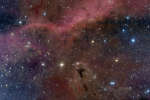 Dark Nebula LDN 1622 and Barnards Loop
6.04.2017
The silhouette of an intriguing dark nebula inhabits this cosmic scene. Lynds' Dark Nebula (LDN) 1622 appears below center against a faint background of glowing hydrogen gas only easily seen in long telescopic exposures of the region.
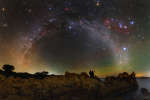 A Night Sky Vista from Sardinia
21.10.2020
How many famous sky objects can you find in this image? The featured dark sky composite combines over 60 exposures spanning over 220 degrees to create a veritable menagerie of night sky wonders. Visible...
 Launch to Lovejoy
21.01.2015
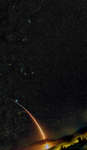
Blasting skyward an Atlas V rocket carrying a U.S. Navy satellite pierces a cloud bank in this starry night scene captured on January 20. On its way to orbit from Space Launch Complex...
 M78 Wide Field
29.12.2017
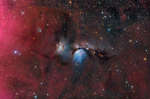
Interstellar dust clouds and glowing nebulae abound in the fertile constellation of Orion. One of the brightest, M78, is centered in this colorful, wide field view, covering an area north of Orion's belt. At a distance of about 1,500 light-years, the bluish reflection nebula is around 5 light-years across.
|
January February March April May June July August September |
|||||||||||||||||||||||||||||||||||||||||||||||||