
|
You entered: Orion
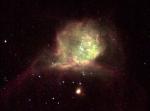 Star Forming Region Hubble X
16.02.2001
In nearby galaxy NGC 6822, this glowing emission nebula complex surrounds bright, massive, newborn stars. A mere 4 million years young, these stars condensed from the galaxy's interstellar gas and dust clouds.
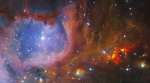 Messier 43
10.07.2015
Often imaged but rarely mentioned, Messier 43 is a large star forming region in its own right. It's just part of the star forming complex of gas and dust that includes the larger, more famous neighboring Messier 42, the Great Orion Nebula.
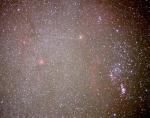 Meteor Milky Way
26.11.1998
The bold, bright star patterns of Orion (right) are a familiar sight to even casual skygazers. But this gorgeous color photo also features a subtler spectacle - the faint stars of the Milky Way.
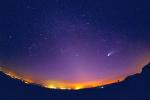 A Fisheye View of Comet Hale-Bopp
25.08.1997
Thousands of stars, several constellations, a planet and a comet all graced the western horizon over Ujue, Spain just after sunset on April 4th, 1997. Because the picture was taken with a fisheye lens, much of the whole night sky is visible. Comet Hale-Bopp, with both tails blazing, appears right of center.
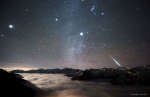 Geminid Fireball over Mount Balang
16.12.2014
This was a sky to remember. While viewing the Geminids meteor shower a few days ago, a bright fireball was captured over Mt. Balang, China with particularly picturesque surroundings. In the foreground, a sea of light clouds slowly floated between dark mountain peaks.
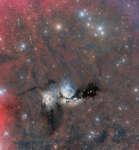 M78 Wide Field
21.01.2021
Interstellar dust clouds and glowing nebulae abound in the fertile constellation of Orion. One of the brightest, M78, is centered in this colorful, wide field view, covering an area north of Orion's belt. At a distance of about 1,500 light-years, the bluish reflection nebula is around 5 light-years across.
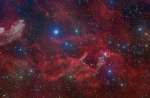 NGC 1788 and the Witch s Whiskers
19.04.2013
This skyscape finds an esthetic balance of interstellar dust and gas residing in the suburbs of the nebula rich constellation of Orion. Reflecting the light of bright star Rigel, Beta Orionis, the jutting, bluish chin of the Witch Head Nebula is at the upper left.
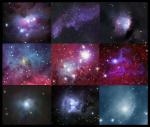 Starlight Reflections
28.12.2001
Interstellar dust grains often find themselves in a reflective "mood". Near a bright star, clouds of these dust particles scatter short wavelengths of visible starlight more readily than long wavelengths, producing lovely blue reflection nebulae. Nine of the more spectacular examples of these dusty, blue stellar neighborhoods have been assembled here by astrophotographer Rob Gendler.
 Canaries Sky
10.04.1999
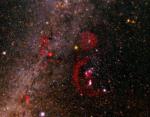
This gorgeous view of stars, nebulae, and the Milky Way comes from the dark night sky above the lovely island of La Palma in the Canaries archipelago. The picture was made by a group...
 M78: Stardust and Starlight
10.10.2013
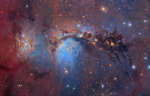
Interstellar dust clouds and bright nebulae abound in the fertile constellation of Orion. One of the brightest, M78, is just left of center in this colorful telescopic view, covering an area north of Orion's belt. At a distance of about 1,500 light-years, the bluish nebula itself is about 5 light-years across.
|
January February March April May June July August September |
|||||||||||||||||||||||||||||||||||||||||||||||||