
|
You entered: sky
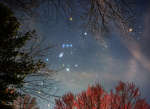 Orion Spring
25.03.2015
As spring comes to planet Earth's northern hemisphere, familiar winter constellation Orion sets in early evening skies and budding trees frame the Hunter's stars. The yellowish hue of cool red supergiant Alpha Orionis, the great star Betelgeuse, mingles with the branches at the top of this colorful skyscape.
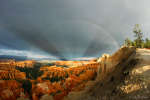 Rainbows and Rays over Bryce Canyon
28.07.2015
What's happening over Bryce Canyon? Two different optical effects that were captured in one image taken earlier this month. Both effects needed to have the Sun situated directly behind the photographer. The nearest...
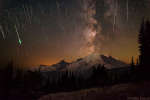 Meteors and Milky Way over Mount Ranier
25.08.2015
Despite appearances, the sky is not falling. Two weeks ago, however, tiny bits of comet dust were. Featured here is the Perseids meteor shower as captured over Mt. Rainier, Washington, USA. The image was created from a two-hour time lapse video, snaring over 20 meteors, including one that brightened dramatically on the image left.
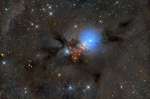 NGC 1333: Stellar Nursery in Perseus
5.11.2015
NGC 1333 is seen in visible light as a reflection nebula, dominated by bluish hues characteristic of starlight reflected by interstellar dust. A mere 1,000 light-years distant toward the heroic constellation Perseus, it lies at the edge of a large, star-forming molecular cloud.
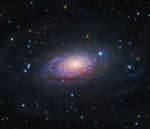 Messier 63: The Sunflower Galaxy
12.07.2017
A bright spiral galaxy of the northern sky, Messier 63 is about 25 million light-years distant in the loyal constellation Canes Venatici. Also cataloged as NGC 5055, the majestic island universe is nearly 100,000 light-years across. That's about the size of our own Milky Way Galaxy.
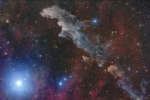 Rigel and the Witch Head Nebula
15.01.2018
By starlight this eerie visage shines in the dark, a crooked profile evoking its popular name, the Witch Head Nebula. In fact, this entrancing telescopic portrait gives the impression that the witch has fixed her gaze on Orion's bright supergiant star Rigel.
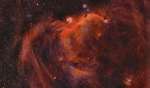 The Seagull and The Duck
16.03.2018
Seen as a seagull and a duck, these nebulae are not the only cosmic clouds to evoke images of flight. But both are winging their way across this broad celestial landscape, spanning almost 7 degrees across planet Earth's night sky toward the constellation Canis Major.
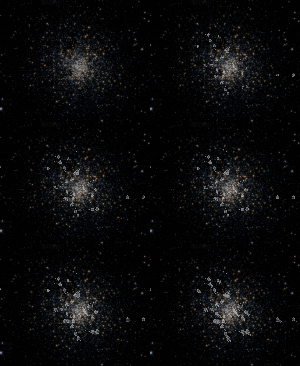 The Gaia Stars of M15
28.03.2019
Messier 15 is a 13 billion year old relic of the early formative years of our galaxy, one of about 170 globular star clusters that still roam the halo of the Milky Way. About 200 light-years in diameter, it lies about 35,000 light years away toward the constellation Pegasus.
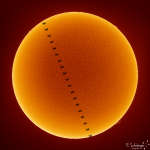 The Space Station Crosses a Spotless Sun
28.10.2019
Typically, the International Space Station is visible only at night. Slowly drifting across the night sky as it orbits the Earth, the International Space Station (ISS) can be seen as a bright spot about once a month from many locations.
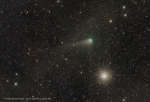 Messier 10 and Comet
21.07.2022
Imaged on July 15 2022, comet C/2017 K2 (PanSTARRS) had a Messier moment, sharing this wide telescopic field of view with globular star cluster Messier 10. Of course M10 was cataloged by 18th century comet hunter Charles Messier as the 10th object on his list of things that were definitely not comets.
|
January February March April May June July August September October |
|||||||||||||||||||||||||||||||||||||||||||||||||