
|
You entered: sky
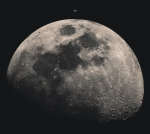 APOD: 2026 April 15 Б The ISS Transits the Moon
14.04.2026
Nope, that is not an alien spaceship landing on the Moon! This is an image of the International Space Station (ISS) as it begins to transit in front of the Moon. The ISS is in low-Earth orbit (LEO) where it wizzes around the Earth every 90 minutes.
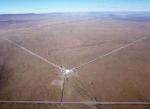 A Step Toward Gravitational Wave Detection
29.10.2000
Accelerate a charge and you'll get electromagnetic radiation: light. But accelerate any mass and you'll get gravitational radiation. Light is seen all the time, but, so far, a confirmed direct detection of gravitational radiation has yet to be made.
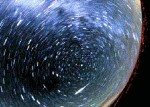 Orionids Meteor Shower to Peak Tonight
21.10.1996
Tonight you might be able to see Halley's Comet again - or at least some pieces of it. It is widely thought that that the meteors from the Orionids meteor shower, which peaks tonight, are just small pieces of Halley's Comet falling to Earth.
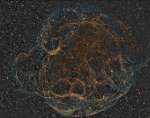 Simeis 147: Supernova Remnant
30.01.2009
It's easy to get lost following the intricate filaments in this detailed image of faint supernova remnant Simeis 147. Also cataloged as Sh2-240 and seen towards the constellation Taurus, it covers nearly 3 degrees (6 full moons) on the sky.
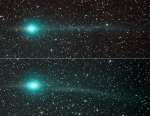 Comet Lulin Tails
6.02.2009
Sweeping through the inner solar system, Comet Lulin is easily visible in both northern and southern hemispheres with binoculars or a small telescope. Recent changes in Lulin's lovely greenish coma and tails are featured in this two panel comparison of images taken on January 31st (top) and February 4th.
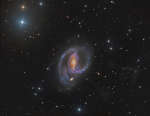 The Jets of NGC 1097
14.11.2013
Enigmatic spiral galaxy NGC 1097 shines in southern skies, about 45 million light-years away in the chemical constellation Fornax. Its blue spiral arms are mottled with pinkish star forming regions in this colorful galaxy portrait.
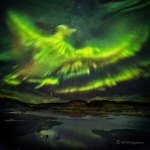 A Phoenix Aurora over Iceland
15.03.2016
All of the other aurora watchers had gone home. By 3:30 am in Iceland, on a quiet night last September, much of that night's auroras had died down. Suddenly though, a new burst of particles streamed down from space, lighting up the Earth's atmosphere once again.
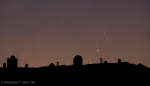 Full Venus and Crescent Moon Rise
13.04.2016
Inner planet Venus and a thin crescent Moon are never found far from the Sun in planet Earth's skies. Taken near dawn on April 6, this timelapse composite shows them both rising just before the Sun. The mountaintop Teide Observatory domes on the fortunate island of Tenerife appear in silhouette against the twilight.
 Cat s Eye Wide and Deep
27.05.2016
The Cat's Eye Nebula (NGC 6543) is one of the best known planetary nebulae in the sky. Its more familiar outlines are seen in the brighter central region of the nebula in this impressive wide-angle view. But the composite image combines many short and long exposures to also reveal an extremely faint outer halo.
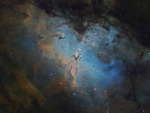 M16 Close Up
9.08.2019
A star cluster around 2 million years young surrounded by natal clouds of dust and glowing gas, M16 is also known as The Eagle Nebula. This beautifully detailed image of the region adopts the colorful Hubble palette and includes cosmic sculptures made famous in Hubble Space Telescope close-ups of the starforming complex.
|
January February March April May June July August September October |
|||||||||||||||||||||||||||||||||||||||||||||||||