
|
You entered: emission
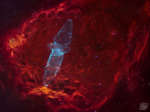 Ou4: A Giant Squid in a Flying Bat
7.10.2020
A very faint but very large squid-like nebula is visible in planet Earth's sky -- but inside a still larger bat. The Giant Squid Nebula cataloged as Ou4, and Sh2-129 also known as the Flying Bat Nebula, are both caught in this cosmic scene toward the royal royal constellation Cepheus.
 APOD: 2024 July 23 Б The Crab Nebula from Visible to X Ray
23.07.2024
What powers the Crab Nebula? A city-sized magnetized neutron star spinning around 30 times a second. Known as the Crab Pulsar, it is the bright spot in the center of the gaseous swirl at the nebula's core.
 APOD: 2025 September 23 Б NGC 6357: Cathedral to Massive Stars
23.09.2025
How massive can a normal star be? Estimates made from distance, brightness and standard solar models had given one star in the open cluster Pismis 24 over 200 times the mass of our Sun, making it one of the most massive stars known.
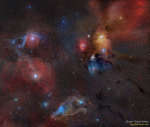 Rho Ophiuchi Wide Field
27.07.2014
The clouds surrounding the star system Rho Ophiuchi compose one of the closest star forming regions. Rho Ophiuchi itself is a binary star system visible in the light-colored region on the image right.
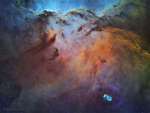 NGC 6188: Dragons of Ara
7.06.2022
Do dragons fight on the altar of the sky? Although it might appear that way, these dragons are illusions made of thin gas and dust. The emission nebula NGC 6188, home to the glowing...
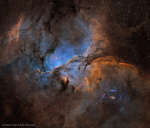 NGC 6188 and NGC 6164
30.03.2016
Fantastic shapes lurk in clouds of glowing gas in the giant star forming region NGC 6188. The emission nebula is found about 4,000 light years away near the edge of a large molecular cloud unseen at visible wavelengths, in the southern constellation Ara.
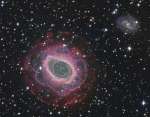 Ring Nebula Deep Field
6.11.2009
A familiar sight to sky enthusiasts with even a small telescope, the Ring Nebula (M57) is some 2,000 light-years away in the musical constellation Lyra. The central ring is about one light-year across...
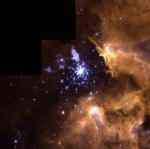 NGC 3603: From Beginning To End
4.06.1999
From beginning to end, different stages of a star's life appear in this exciting Hubble Space Telescope picture of the environs of galactic emission nebula NGC 3603. For the beginning, eye-catching "pillars" of glowing hydrogen at the right signal newborn stars emerging from their dense, gaseous, nurseries.
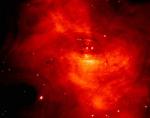 The Pulsar Powered Crab
2.06.2001
In the Summer of 1054 A.D. Chinese astronomers reported that a star in the constellation of Taurus suddenly became as bright as the full Moon. Fading slowly, it remained visible for over a year.
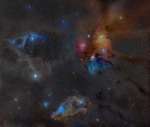 Rho Ophiuchus Wide Field
24.05.2010
The clouds surrounding the star system Rho Ophiucus compose one of the closest star forming regions. Rho Ophiucus itself is a binary star system visible in the light-colored region on the image right.
|
January February March April May June July August |
||||||||||||||||||||||||||||||||||||||||||||||||||||||||