
|
You entered: emission
 A View Toward M106
22.02.2024
Big, bright, beautiful spiral, Messier 106 dominates this cosmic vista. The nearly two degree wide telescopic field of view looks toward the well-trained constellation Canes Venatici, near the handle of the Big Dipper. Also...
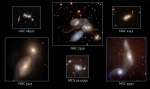 Black Holes in Merging Galaxies
29.05.2010
Violent galaxy mergers can feed supermassive black holes. Theoretically, the result is intense emission from regions near the supermassive black holes, creating the some of the most luminous objects in the universe. Astronomers dub these Active Galactic Nuclei, or just AGN.
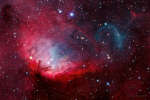 The Tulip and Cygnus X 1
16.02.2017
Framing a bright emission region, this telescopic view looks out along the plane of our Milky Way Galaxy toward the nebula rich constellation Cygnus the Swan. Popularly called the Tulip Nebula, the reddish glowing cloud of interstellar gas and dust is also found in the 1959 catalog by astronomer Stewart Sharpless as Sh2-101.
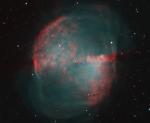 M27: Not A Comet
3.08.2006
While searching the skies above 18th century France for comets, astronomer Charles Messier diligently recorded this object as number 27 on his list of things which are definitely not comets. So what is it?
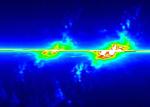 Streaming From A Black Hole
13.06.1997
Glowing gas clouds are streaming from the core of galaxy NGC4151 at hundreds of thousands of miles per hour. A powerful tool, the Hubble Space Telescope's new STIS instrument, makes it possible to map out the cloud velocities - producing this false color "velocity map" for the central regions of NGC4151.
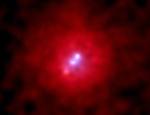 3C 295: X-rays From A Giant Galaxy
25.11.1999
Did this galaxy eat too much? Five billion light-years away, the giant elliptical galaxy 3C295 is a prodigious source of energy at radio wavelengths. Bright knots of X-ray emission are also seen at the center of this false-color Chandra Observatory image of the region.
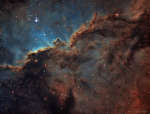 APOD: 2020 July 28 Б NGC 6188: The Dragons of Ara
28.07.2020
Dark shapes with bright edges winging their way through dusty NGC 6188 are tens of light-years long. The emission nebula is found near the edge of an otherwise dark and large molecular cloud in the southern constellation Ara, about 4,000 light-years away.
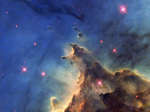 NGC 2174: Stars Versus Mountains
9.02.2011
It's stars versus gas mountains in NGC 2174 and the stars are winning. More precisely, the energetic light and winds from massive newly formed stars are evaporating and dispersing the dark stellar nurseries in which they formed.
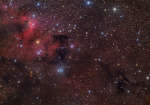 The Light, the Dark, and the Dusty
11.06.2015
This colorful skyscape spans about three full moons (1.5 degrees) across nebula rich starfields along the plane of our Milky Way Galaxy in the royal northern constellation Cepheus. Near the edge of the region...
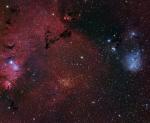 The Cone Nebula Neighborhood
12.04.2007
Cosmic clouds of hydrogen gas and dust abound in this gorgeous skyscape, stretching through Monocerous in the neighborhood of The Cone Nebula. A dark, obscuring dust cloud, the simple, sculpted shape of the Cone Nebula is near the lower left edge.
|
January February March April May June July August |
||||||||||||||||||||||||||||||||||||||||||||||||||||||||