
|
You entered: emission
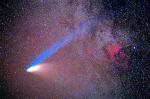 Hale Bopp and the North American Nebula
9.10.1997
Comet Hale-Bopp's recent encounter with the inner Solar System allowed many breath-taking pictures. Above, Comet Hale-Bopp was photographed on March 8th in the constellation of Cygnus. Visible on the right in red is the North American Nebula, a bright emission nebula observable from a dark location with binoculars.
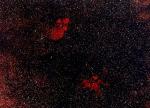 The Cat's Paw Nebula
7.12.1999
As soon as we find out whose cat did this . . . Nebulae are as famous for being identified with familiar shapes as perhaps cats are for getting into trouble. No cat, though, could have created the vast Cat's Paw Nebula visible in Scorpius.
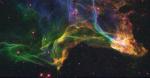 The Cygnus Loop
23.06.2001
The shockwave from a 20,000 year-old supernova in the constellation of Cygnus supernova explosion is still expanding into interstellar space. The collision of this fast moving wall of gas with a stationary cloud...
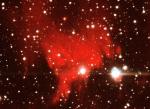 Nebula Nova Cygni Turns On
25.08.2002
Old photographs show no evidence of the above nebula. In 1992, a white dwarf star toward the constellation of Cygnus blew off its outer layers in a classical nova explosion: an event called Nova Cygni 1992.
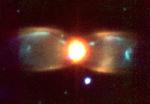 The Butterfly Planetary Nebula
21.10.1997
As stars age, they throw off their outer layers. Sometimes a highly symmetric gaseous planetary nebula is created, as is the case in M2-9, also called the Butterfly. Most planetary nebulae show this bipolar appearance, although some appear nearly spherical.
 Nebula Nova Cygni Turns On
16.01.2005
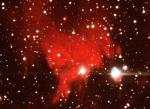
Old photographs show no evidence of the above nebula. In 1992, a white dwarf star toward the constellation of Cygnus blew off its outer layers in a classical nova explosion: an event called Nova Cygni 1992.
 The Coma Cluster of Galaxies
21.03.2006
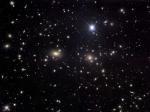
Almost every object in the above photograph is a galaxy. The Coma Cluster of Galaxies pictured above is one of the densest clusters known - it contains thousands of galaxies. Each of these galaxies houses billions of stars - just as our own Milky Way Galaxy does.
 The Dark River to Antares
3.06.2008
Connecting the Pipe Nebula to the bright star Antares is a flowing dark cloud nicknamed the Dark River. The murkiness of the Dark River is caused by absorption of background starlight by dust, although the nebula contains mostly hydrogen and molecular gas.
 The Coma Cluster of Galaxies
2.05.2010
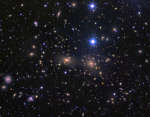
Almost every object in the above photograph is a galaxy. The Coma Cluster of Galaxies pictured above is one of the densest clusters known - it contains thousands of galaxies. Each of these galaxies houses...
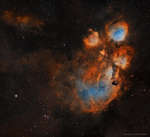 NGC 6334: The Cats Paw Nebula
13.09.2017
Nebulas are perhaps as famous for being identified with familiar shapes as perhaps cats are for getting into trouble. Still, no known cat could have created the vast Cat's Paw Nebula visible in Scorpius.
|
January February March April May June July August |
||||||||||||||||||||||||||||||||||||||||||||||||||||||||