
|
You entered: emission
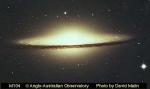 M104: The Sombrero Galaxy
23.02.1998
What's going on in the center of this spiral galaxy? Named the Sombrero Galaxy for its hat-like resemblance, M104 features a prominent dust lane and a bright halo of stars and globular clusters.
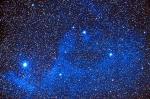 Starlight Reflections
14.04.1998
Wisps of dust fill the space between the stars. This dust is usually invisible, subtly acting to dim the light of more distant stars. Sometimes this dust is thick and prominent as dark patches on otherwise bright emission nebulae. Other times this dust may show itself by reflecting the light of bright, nearby stars.
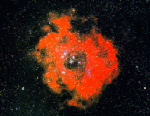 NGC 2237: The Rosette Nebula
14.02.1996
Would the Rosette nebula by any other name look as sweet? The bland New General Catalog designation of NGC 2237 doesn't appear to diminish the appearance of the this flowery emission nebula. Inside the nebula lies an open cluster of bright young stars designated NGC 2244.
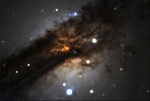 Dusty Galaxy Centaurus A
28.08.1995
One of the most unusual galaxies known, Centaurus A, is pictured above. Cen A is marked by dramatic dust lanes that run across the galaxy's center. These dust lanes are so thick they almost completely obscure the galaxy's center in visible light.
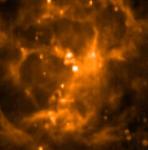 Infrared Trifid
28.08.1997
The Trifid nebula (M20) is a bright star forming region in Sagittarius, 5000 light years from Earth. In visible light, the interstellar gas cloud is crossed by dark, obscuring dust lanes which roughly divide the glowing emission nebula into three major parts.
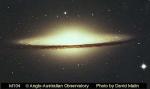 M104: The Sombrero Galaxy
15.08.1999
What's going on in the center of this spiral galaxy? Named the Sombrero Galaxy for its hat-like resemblance, M104 features a prominent dust lane and a bright halo of stars and globular clusters.
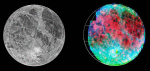 Fields of Minerals on Ganymede
7.11.1996
What treasures lie on the surface of Ganymede? Last week, NASA released a map of Jupiter's largest moon made by the Galileo Orbiter highlighting ice and minerals deposits. The leftmost photograph by Voyager...
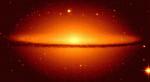 M104: The Sombrero Galaxy
8.02.1997
The famous Sombrero galaxy (M104) is a bright nearby spiral galaxy. The prominent dust lane and halo of stars and globular clusters give this galaxy its name. Something very energetic is going on in the Sombrero's center, as much X-ray light has been detected from it.
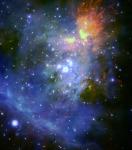 The Orion Nebula from Subaru
2.02.1999
The Orion Nebula (M42) shows a host of treasures when viewed in infrared light. Some stars in the Trapezium, an open cluster of stars at the center, are only visible in infrared light. The orange feature above center is called the Kleinman-Low Nebula, and appears greatly affected by newly forming central star IRc2.
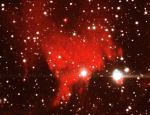 Nebula Nova Cygni Turns On
16.12.1996
Old photographs show no evidence of the above nebula. In 1992, a white dwarf star in Cygnus blew off its outer layers in a classical nova explosion: an event called Nova Cygni 1992. Light flooded the local interstellar neighborhood, illuminated this existing gas cloud, excited the existing hydrogen, and hence caused the red emission.
|
January February March April May June July August |
||||||||||||||||||||||||||||||||||||||||||||||||||||||||