
|
You entered: sky
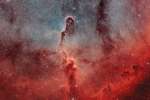 The Elephant's Trunk in IC 1396
6.11.2010
Like an illustration in a galactic Just So Story, the Elephant's Trunk Nebula winds through the emission nebula and young star cluster complex IC 1396, in the high and far off constellation of Cepheus. Of course, the cosmic elephant's trunk is over 20 light-years long.
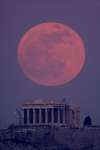 Parthenon Moon
20.03.2011
Did you see the Full Moon last night? Near the horizon, the lunar orb may have seemed to loom large, swollen in appearance by the famous Moon illusion. But the Full Moon really...
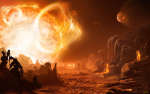 A Dangerous Sunrise on Gliese 876d
29.04.2012
On planet Gliese 876d, sunrises might be dangerous. Although nobody really knows what conditions are like on this close-in planet orbiting variable red dwarf star Gliese 876, the above artistic illustration gives one impression.
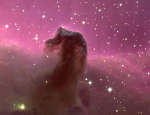 The Horsehead Nebula
21.10.2012
One of the most identifiable nebulae in the sky, the Horsehead Nebula in Orion, is part of a large, dark, molecular cloud. Also known as Barnard 33, the unusual shape was first discovered on a photographic plate in the late 1800s.
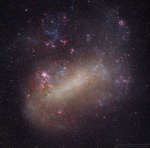 The Large Cloud of Magellan
28.05.2013
The 16th century Portuguese navigator Ferdinand Magellan and his crew had plenty of time to study the southern sky during the first circumnavigation of planet Earth. As a result, two fuzzy cloud-like objects easily...
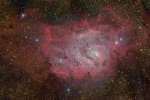 M8: The Lagoon Nebula
17.08.2013
This beautiful cosmic cloud is a popular stop on telescopic tours of the constellation Sagittarius. Eighteenth century cosmic tourist Charles Messier cataloged the bright nebula as M8. Modern day astronomers recognize the Lagoon Nebula as an active stellar nursery about 5,000 light-years distant, in the direction of the center of our Milky Way Galaxy.
 Andromeda on the Rocks
27.09.2013
How far can you see? The Andromeda Galaxy 2.5 million light years away is the most distant object easily seen by the unaided eye. Other apparent denizens of the night sky, stars, clusters...
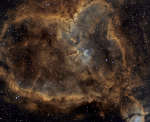 IC 1805: Light from the Heart
14.02.2014
Sprawling across almost 200 light-years, emission nebula IC 1805 is a mix of glowing interstellar gas and dark dust clouds about 7,500 light-years away in the Perseus spiral arm of our galaxy. Stars were born in this region whose nickname, the Heart Nebula, derives from its Valentine's-Day-appropriate shape.
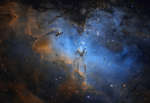 M16 and the Eagle Nebula
15.10.2015
A star cluster around 2 million years young surrounded by natal clouds of dust and glowing gas, M16 is also known as The Eagle Nebula. This beautifully detailed image of the region includes cosmic sculptures made famous in Hubble Space Telescope close-ups of the starforming complex.
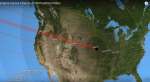 Eclipse Across America: Path Prediction Video
19.06.2017
Where will you be during the Eclipse across America? On August 21, the shadow of the Moon will cross the continental USA for the first time since 1979. The predicted path -- a certainty given modern astronomical knowledge -- is shown in the featured NASA video.
|
January February March April May June July August September October |
|||||||||||||||||||||||||||||||||||||||||||||||||