
|
You entered: sky
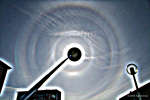 Pyramid Ice Crystal Halos Over Finland
18.06.2008
What if the atmosphere above you became one gigantic lens? This actually happens when a nearly transparent sheet of pyramid shaped ice crystals falls from the sky in a common orientation. These ice-crystals...
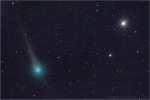 Lulin and Saturn near Opposition
27.02.2009
Tracking through the constellation Leo on February 23rd, bright planet Saturn and Comet Lulin were both near opposition -- opposite the Sun in planet Earth's sky. They also passed within only 2 degrees of each other creating a dramatic celestial photo-op.
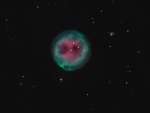 M97: The Owl Nebula
15.05.2009
The Owl Nebula is perched in the sky about 2,600 light-years away toward the bottom of the Big Dipper's bowl. Also cataloged as M97, the 97th object in Messier's well-known list, its round shape along with the placement of two large, dark "eyes" do suggest the face of a staring owl.
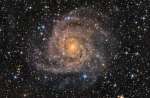 Hidden Galaxy IC 342
18.07.2013
Similar in size to large, bright spiral galaxies in our neighborhood, IC 342 is a mere 10 million light-years distant in the long-necked, northern constellation Camelopardalis. A sprawling island universe, IC 342 would otherwise...
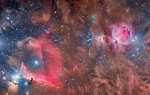 Horsehead and Orion Nebulas
29.10.2013
The dark Horsehead Nebula and the glowing Orion Nebula are contrasting cosmic vistas. Adrift 1,500 light-years away in one of the night sky's most recognizable constellations, they appear in opposite corners of the above stunning mosaic.
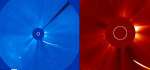 Surprising Comet ISON
30.11.2013
After failing to appear for Sun staring spacecraft at perihelion, its harrowing closest approach to the Sun, sungrazing Comet ISON was presumed lost. But ISON surprised observers yesterday as material still traveling along the comet's trajectory became visible and even developed an extensive fan-shaped dust tail.
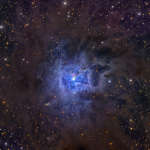 NGC 7023: The Iris Nebula
2.08.2014
These clouds of interstellar dust and gas have blossomed 1,300 light-years away in the fertile star fields of the constellation Cepheus. Sometimes called the Iris Nebula, NGC 7023 is not the only nebula in the sky to evoke the imagery of flowers, though.
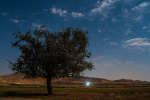 Perseid in Moonlight
15.08.2014
Bright moonlight from a Full Moon near perigee illuminates the night and casts shadows in this skyscape from central Iran. Taken on August 12, near the peak of the annual Perseid meteor shower the exposure also captures a bright and colorful perseid streak above the shady tree in the foreground.
 In the Heart of the Virgo Cluster
7.04.2015
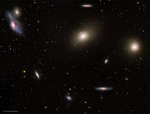
The Virgo Cluster of Galaxies is the closest cluster of galaxies to our Milky Way Galaxy. The Virgo Cluster is so close that it spans more than 5 degrees on the sky - about 10 times the angle made by a full Moon.
 Asteroid 2014 JO25
20.04.2017
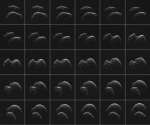
A day before its closest approach, asteroid 2014 JO25 was imaged by radar with the 70-meter antenna of NASA's Goldstone Deep Space Communications Complex in California. This grid of 30 radar images, top left to lower right, reveals the two-lobed shape of the asteroid that rotates about once every five hours.
|
January February March April May June July August September October |
|||||||||||||||||||||||||||||||||||||||||||||||||