
|
You entered: sky
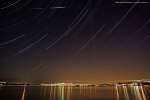 Perseid over Vancouver
16.08.2008
Colorful and bright, the city lights of Vancouver, Canada are reflected in the water in this portrait of the world at night. Recorded on August 12 during the Perseid Meteor Shower, the wide-angle view takes in a large swath along the photographer's eastern horizon.
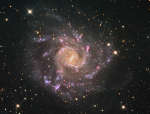 Grand Spiral Galaxy NGC 7424
8.01.2013
The grand, winding arms are almost mesmerizing in this face-on view of NGC 7424, a spiral galaxy with a prominent central bar. About 40 million light-years distant in the headlong constellation Grus, this island universe is also about 100,000 light-years across making it remarkably similar to our own Milky Way.
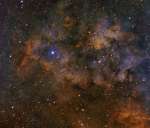 Sharpless 115
14.06.2013
Sharpless 115 stands just north and west of Deneb, the alpha star of Cygnus the Swan in planet Earth's skies. Noted in the 1959 catalog by astronomer Stewart Sharpless (as Sh2-115) the faint...
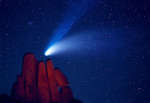 Comet Hale Bopp Over Indian Cove
24.11.2013
Comet Hale-Bopp, the Great Comet of 1997, was quite a sight. In the above photograph taken on 1997 April 6, Comet Hale-Bopp was imaged from the Indian Cove Campground in the Joshua Tree National Park in California, USA. A flashlight was used to momentarily illuminate foreground rocks in this six minute exposure.
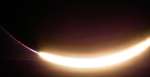 A Total Solar Eclipse Close Up in Real Time
12.09.2017
How would you feel if the Sun disappeared? Many eclipse watchers across the USA surprised themselves with the awe that they felt and the exclamations that they made as the Sun momentarily disappeared behind the Moon.
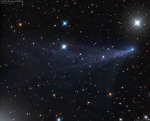 Blue Comet PanSTARRS
12.01.2018
Discovered with the PanSTARRS telescope on September 7, 2016, this Comet PanSTARRS, C/2016 R2, is presently about 24 light minutes (3 AU) from the Sun, sweeping through planet Earth's skies across the background of stars in the constellation Taurus.
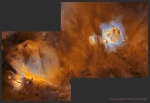 Horsehead and Orion Nebulas
18.03.2019
The dark Horsehead Nebula and the glowing Orion Nebula are contrasting cosmic vistas. Adrift 1,500 light-years away in one of the night sky's most recognizable constellations, they appear in opposite corners of the above stunning two-panel mosaic.
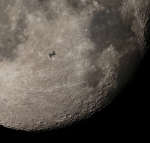 Moon over ISS
6.11.2020
Completing one orbit of our fair planet in 90 minutes the International Space Station can easily be spotted by eye as a very bright star moving through the night sky. Have you seen it? The next time you do, you will have recognized the location of over 20 years of continuous human presence in space.
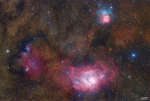 A Sagittarius Triplet
26.04.2021
These three bright nebulae are often featured on telescopic tours of the constellation Sagittarius and the crowded starfields of the central Milky Way. In fact, 18th century cosmic tourist Charles Messier cataloged two of them; M8, the large nebula below and right of center, and colorful M20 near the top of the frame.
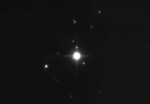 In Motion: Uranus and Moons
30.11.2021
What's that moving across the sky? A planet just a bit too faint to see with the unaided eye: Uranus. The gas giant out past Saturn was tracked earlier this month near opposition -- when it was closest to Earth and at its brightest.
|
January February March April May June July August September October |
|||||||||||||||||||||||||||||||||||||||||||||||||