
|
You entered: sky
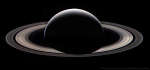 Saturn at Night
11.09.2021
Still bright in planet Earth's night skies, good telescopic views of Saturn and its beautiful rings often make it a star at star parties. But this stunning view of Saturn's rings and night side just isn't possible from telescopes closer to the Sun than the outer planet.
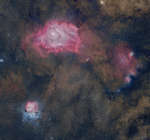 A Sagittarius Triplet
10.07.2024
These three bright nebulae are often featured on telescopic tours of the constellation Sagittarius and the crowded starfields of the central Milky Way. In fact, 18th century cosmic tourist Charles Messier cataloged two of them; M8, the large nebula above center, and colorful M20 below and left in the frame.
 APOD: 2025 July 4 Б NGC 6946 and NGC 6939
4.07.2025
Face-on spiral galaxy NGC 6946 and open star cluster NGC 6939 share this cosmic snapshot, composed with over 68 hours of image data captured with a small telescope on planet Earth. The field of view spans spans about 1 degree or 2 full moons on the sky toward the northern constellation Cepheus.
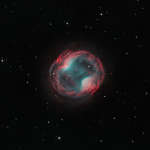 APOD: 2026 May 27 Б PK 164 +31.1: The Headphone Nebula
27.05.2026
What is a pair of headphones doing in the sky? TodayБs image features the Headphone Nebula, also known as PK 164 +31.1 or Jones-Emberson 1. This planetary nebula, the remnant of a dying Sun-like star, faintly occupies an angular region of the Lynx constellation about 1/5 th the diameter of the full moon.
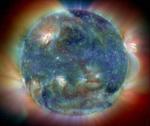 Solstice Celebration
21.06.2000
Season's greetings! At 01:48 Universal Time on June 21 the Sun reaches its northernmost point in planet Earth's sky marking a season change and the first solstice of the year 2000. In celebration, consider this delightfully detailed, brightly colored image of the active Sun.
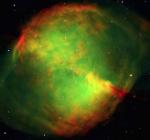 M27: Not A Comet
2.03.2002
While searching the skies above 18th century France for comets, astronomer Charles Messier diligently recorded this object as number 27 on his list of things which are definitely not comets. So what is it?
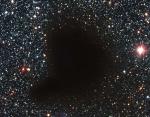 Molecular Cloud Barnard 68
2.02.2003
Where did all the stars go? What used to be considered a hole in the sky is now known to astronomers as a dark molecular cloud. Here, a high concentration of dust and molecular gas absorb practically all the visible light emitted from background stars.
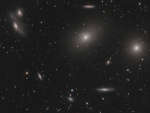 In the Heart of the Virgo Cluster
8.07.2008
The Virgo Cluster of Galaxies is the closest cluster of galaxies to our Milky Way Galaxy. The Virgo Cluster is so close that it spans more than 5 degrees on the sky - about 10 times the angle made by a full Moon.
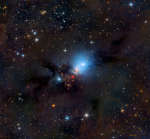 NGC 1333 Stardust
6.03.2014
NGC 1333 is seen in visible light as a reflection nebula, dominated by bluish hues characteristic of starlight reflected by dust. A mere 1,000 light-years distant toward the heroic constellation Perseus, it lies at the edge of a large, star-forming molecular cloud.
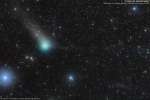 Comet PanSTARRS in the Southern Fish
17.06.2016
Now approaching our fair planet this Comet PanSTARRS (C/2013 X1) will come closest on June 21-22, a mere 5.3 light-minutes away. By then its appearance low in northern hemisphere predawn skies (high in the south), will be affected by the light of a nearly Full Moon, though.
|
January February March April May June July August September October |
|||||||||||||||||||||||||||||||||||||||||||||||||