
|
You entered: sky
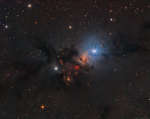 NGC 1333: Stellar Nursery in Perseus
27.03.2019
NGC 1333 is seen in visible light as a reflection nebula, dominated by bluish hues characteristic of starlight reflected by interstellar dust. A mere 1,000 light-years distant toward the heroic constellation Perseus, it lies at the edge of a large, star-forming molecular cloud.
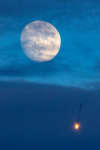 A Falcon 9 Moon
5.09.2020
Illuminating planet Earth's night, full moons can have many names. This year the last full moon of northern hemisphere summer was on September 2, known to some as the Full Corn Moon.
 APOD: 2024 December 31 Б The Twisted Disk of NGC 4753
31.12.2024
What do you think this is? HereБs a clue: it's bigger than a bread box. Much bigger. The answer is that pictured NGC 4753 is a twisted disk galaxy, where unusual dark dust filaments provide clues about its history.
 APOD: 2025 January 20 Б Comet ATLAS Rounds the Sun
20.01.2025
Why does Comet ATLAS have such colorful tails? Last week Comet C/2024 G3 (ATLAS) passed its closest to the Sun -- well inside the orbit of Mercury -- and brightened dramatically. Unfortunately, the comet was then so angularly near the Sun that it was very hard for humans to see. But NASA's SOHO spacecraft saw it.
 APOD: 2025 February 24 Б Light Pillar over Erupting Etna
24.02.2025
Can a lava flow extend into the sky? No, but light from the lava flow can. One effect is something quite unusual -- a volcanic light pillar. More typically, light pillars are caused by sunlight and so appear as a bright column that extends upward above a rising or setting Sun.
 APOD: 2025 July 5 Б Ou4: The Giant Squid Nebula
5.07.2025
Difficult to capture, this mysterious, squid-shaped interstellar cloud spans nearly three full moons in planet Earth's sky. Discovered in 2011 by French astro-imager Nicolas Outters, the Squid Nebula's bipolar shape is distinguished here by the telltale blue emission from doubly ionized oxygen atoms.
 APOD: 2025 July 19 Б Messier 6
19.07.2025
The sixth object in Charles Messier's famous catalog of things which are not comets, Messier 6 is a galactic or open star cluster. A gathering of 100 stars or so, all around 100 million years young, M6 lies some 1,600 light-years away toward the central Milky Way in the constellation Scorpius.
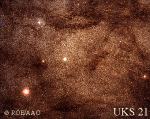 Lensing through Baade's Window
1.02.1996
What is the shape and composition of our Milky Way Galaxy? This question would be easier to answer if there wasn't so much obscuring dust! In the 1940s, however, astronomer Walter Baade identified a "window" near the center of our Galaxy where there is comparatively little opaque dust.
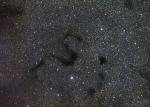 Snake in the Dark
20.06.2003
Dark nebulae snake across a gorgeous expanse of stars in this wide-field view toward the pronounceable constellation Ophiucus and the center of our Milky Way Galaxy. In fact, the central S-shape seen here is well known as the Snake Nebula.
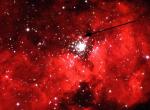 Sher 25: A Pending Supernova?
12.08.1997
No supernova has ever been predicted - yet. These dramatic stellar explosions that destroy stars, that create and disperse the elements that compose people and planets, that light up the night sky, are not so well understood that astronomers can accurately predict when a star will explode - yet. Perhaps Sher 25 will be the first.
|
January February March April May June July August September October |
|||||||||||||||||||||||||||||||||||||||||||||||||