
|
You entered: sky
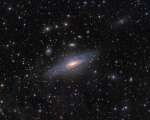 NGC 7331 and Beyond
12.08.2011
Big, beautiful spiral galaxy NGC 7331 is often touted as an analog to our own Milky Way. About 50 million light-years distant in the northern constellation Pegasus, NGC 7331 was recognized early on as a spiral nebula and is actually one of the brighter galaxies not included in Charles Messier's famous 18th century catalog.
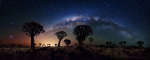 Milky Way Over Quiver Tree Forest
12.12.2012
In front of a famous background of stars and galaxies lies some of Earth's more unusual trees. Known as quiver trees, they are actually succulent aloe plants that can grow to tree-like proportions. The quiver tree name is derived from the historical usefulness of their hollowed branches as dart holders.
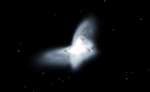 Galaxy Collisions: Simulation vs Observations
14.05.2013
What happens when two galaxies collide? Although it may take over a billion years, such titanic clashes are quite common. Since galaxies are mostly empty space, no internal stars are likely to themselves collide.
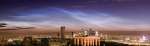 Noctilucent Clouds over Moscow
27.06.2013
This panoramic night scene from June 8 looks out across a Moscow skyline from atop the main building of Lomonosov Moscow State University. Shining in the darkened sky above are widespread noctilucent clouds. From...
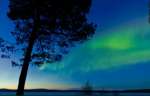 Time Lapse Auroras Over Norway
29.12.2013
Sometimes, after your eyes adapt to the dark, a spectacular sky appears. Such was the case in 2011 March when one of the largest auroral displays in recent years appeared over northern locations like the border between Norway and Russia.
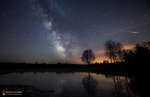 Halley Dust and Milky Way
9.05.2014
The early morning hours of May 6 were moonless when grains of cosmic dust streaked through dark skies. Swept up as planet Earth plows through dusty debris streams left behind periodic Comet Halley, the annual meteor shower is known as the Eta Aquarids.
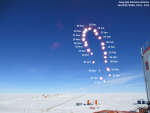 Antarctic Analemma
23.09.2015
Does the Sun return to the same spot on the sky every day? No. A better and more visual answer to that question is an analemma, a composite image taken from the same spot at the same time over the course of a year.
 Orion in Red and Blue
13.04.2016
When did Orion become so flashy? This colorful rendition of part of the constellation of Orion comes from red light emitted by hydrogen and sulfur (SII), and blue-green light emitted by oxygen (OIII). Hues...
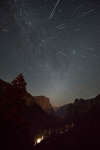 Perseid Night at Yosemite
18.08.2016
The 2016 Perseid meteor shower performed well on the night of August 11/12. The sky on that memorable evening was recorded from a perch overlooking Yosemite Valley, planet Earth, in this scene composed of 25 separate images selected from an all-night set of sequential exposures.
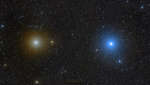 Gemini Stars Pollux and Castor
16.05.2017
Who are the twins of Gemini? It terms of astronomical objects, the famous constellation is dominated by two bright stars: Pollux (left) and Castor (right). Pictured, the two stars stand out because they are so bright, so close together both in angle and brightness, but so different in color.
|
January February March April May June July August September October |
|||||||||||||||||||||||||||||||||||||||||||||||||