
|
You entered: sky
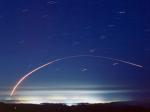 Aura Launch
22.07.2004
In this alluring time exposure, star trails arc across the night sky above Monterey Bay and the lights of Santa Cruz, California, USA. But since the exposure began around 3:01am PDT on July 15 it also records the long trail of a Delta II rocket lofting NASA's Aura spacecraft into Earth orbit.
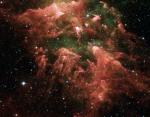 Sculpting the South Pillar
2.06.2005
Eta Carinae, one of the most massive and unstable stars in the Milky Way Galaxy, has a profound affect on its environment. Found in the the South Pillar region of the Carina Nebula, these...
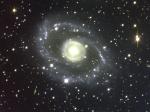 Spiral Galaxy In Centaurus
27.01.2000
Centaurus, the Centaur, is one of the most striking constellations in the southern sky. The lovely Milky Way flows through this large constellation whose celestial wonders also include the closest star to the sun, Alpha Centauri, the largest globular star cluster in our galaxy, Omega Centauri, and the closest active galaxy, Centaurus A.
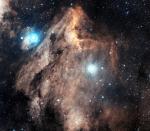 A Pelican in the Swan
30.11.2006
The Pelican Nebula lies about 2,000 light-years away in the high flying constellation Cygnus, the Swan. Also known as IC 5070, this cosmic pelican is appropriately found just off the "east coast" of the North America Nebula (NGC 7000), another surprisingly familiar looking emission nebula in Cygnus.
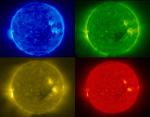 The View from Stereo Ahead
22.12.2006
On December 22nd, at 0022 Universal Time the Sun reached its southernmost point in Earth's sky marking the final season change for the year 2006. In celebration of the Solstice, consider these images of the Sun from an extreme ultraviolet telescope onboard the Stereo Ahead spacecraft.
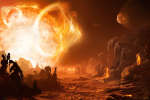 A Dangerous Sunrise on Gliese 876d
21.05.2008
On planet Gliese 876d, sunrises might be dangerous. Although nobody really knows what conditions are like on this close-in planet orbiting variable red dwarf star Gliese 876, the above artistic illustration gives one impression.
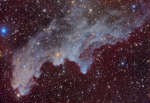 IC 2118: The Witch Head Nebula
17.01.2012
Double, double toil and trouble; Fire burn, and cauldron bubble -- maybe Macbeth should have consulted the Witch Head Nebula. This suggestively shaped reflection nebula is associated with the bright star Rigel in the constellation Orion.
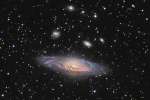 NGC 7331 and Beyond
1.03.2014
Big, beautiful spiral galaxy NGC 7331 is often touted as an analog to our own Milky Way. About 50 million light-years distant in the northern constellation Pegasus, NGC 7331 was recognized early on as a spiral nebula and is actually one of the brighter galaxies not included in Charles Messier's famous 18th century catalog.
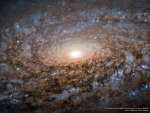 In the Center of Spiral Galaxy NGC 3521
30.11.2015
This huge swirling mass of stars, gas, and dust occurs near the center of a nearby spiral galaxy. Gorgeous spiral NGC 3521 is a mere 35 million light-years distant, toward the constellation Leo. Spanning some 50,000 light-years, its central region is shown in this dramatic image, constructed from data from the Hubble Space Telescope.
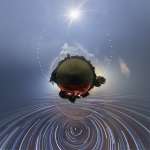 Little Planet Astro Camp
2.09.2016
Day and night on this little planet look a lot like day and night on planet Earth. In fact, the images used to construct the little planet projection, a digitally warped and stitched mosaic covering 360x180 degrees, were taken during day and night near Tarján, Hungary, planet Earth.
|
January February March April May June July August September October |
|||||||||||||||||||||||||||||||||||||||||||||||||