
|
You entered: sky
 Mercury Spotting
27.05.2012
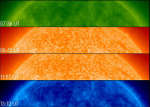
Can you spot the planet? The diminutive disk of Mercury, the solar system's innermost planet, spent about five hours crossing in front of the enormous solar disk in 2003, as viewed from the general vicinity of planet Earth.
 NGC 7023: The Iris Nebula
29.09.2012
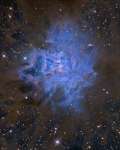
Like delicate cosmic petals, these clouds of interstellar dust and gas have blossomed 1,300 light-years away in the fertile star fields of the constellation Cepheus. Sometimes called the Iris Nebula and dutifully cataloged as NGC 7023 this is not the only nebula in the sky to evoke the imagery of flowers.
 NGC 4372 and the Dark Doodad
31.01.2013
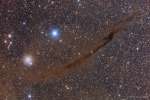
The delightful Dark Doodad Nebula drifts through southern skies, a tantalizing target for binoculars in the constellation Musca, The Fly. The dusty cosmic cloud is seen against rich starfields just south of the prominent Coalsack Nebula and the Southern Cross.
 Globular Star Cluster NGC 6752
5.07.2013
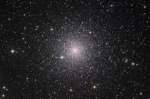
Some 13,000 light-years away toward the southern constellation Pavo, the globular star cluster NGC 6752 roams the halo of our Milky Way galaxy. Over 10 billion years old, NGC 6752 follows clusters Omega Centauri and 47 Tucanae as the third brightest globular in planet Earth's night sky.
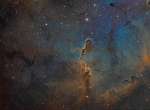 The Elephant s Trunk in IC 1396
26.07.2013
Like an illustration in a galactic Just So Story, the Elephant's Trunk Nebula winds through the emission nebula and young star cluster complex IC 1396, in the high and far off constellation of Cepheus. Of course, the cosmic elephant's trunk is over 20 light-years long.
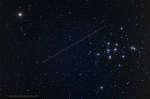 Close Encounter with M44
28.01.2015
On Monday, January 26, well-tracked asteroid 2004 BL86 made its closest approach, a mere 1.2 million kilometers from our fair planet. That's about 3.1 times the Earth-Moon distance or 4 light-seconds away. Moving...
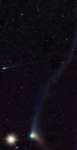 Comets and Bright Star
6.01.2016
This timely, telescopic, two panel mosaic spans about 10 full moons across planet Earth's predawn skies. Recorded as the year began from Tenerife, Canary Islands, near the top of the frame are the faint coma and tail of Comet Borrelly (P/19).
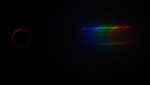 The Flash Spectrum of the Sun
12.03.2016
In a flash, the visible spectrum of the Sun changed from absorption to emission on March 9 during the total solar eclipse. That fleeting moment, at the beginning the total eclipse phase, is captured by telephoto lens and diffraction grating in this image from clearing skies over Ternate, Indonesia.
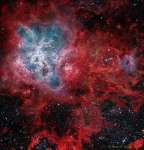 The Cosmic Web of the Tarantula Nebula
8.11.2016
It is the largest and most complex star forming region in the entire galactic neighborhood. Located in the Large Magellanic Cloud, a small satellite galaxy orbiting our Milky Way galaxy, the region's spidery appearance is responsible for its popular name, the Tarantula nebula. This tarantula, however, is about 1,000 light-years across.
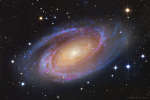 Bright Spiral Galaxy M81
17.09.2017
One of the brightest galaxies in planet Earth's sky is similar in size to our Milky Way Galaxy: big, beautiful M81. This grand spiral galaxy can be found toward the northern constellation of the Great Bear (Ursa Major).
|
January February March April May June July August September October |
|||||||||||||||||||||||||||||||||||||||||||||||||