
|
You entered: sky
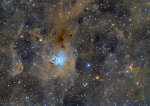 Haunting the Cepheus Flare
29.10.2021
Spooky shapes seem to haunt this dusty expanse, drifting through the night in the royal constellation Cepheus. Of course, the shapes are cosmic dust clouds visible in dimly reflected starlight. Far from your...
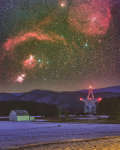 Orion over Green Bank
23.02.2022
What will the huge Green Bank Telescope discover tonight? Pictured, the Robert C. Byrd Green Bank Telescope (GBT) on the lower right is the largest fully-pointable single-dish radio telescope in the world. With...
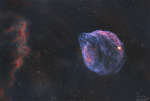 APOD: 2023 March 29 Б Sh2-308: A Dolphin Shaped Star Bubble
29.03.2023
Which star created this bubble? It wasn't the bright star on the bubble's right. And it also wasn't a giant space dolphin. It was the star in the blue nebula's center, a famously energetic Wolf-Rayet star.
 APOD: 2024 April 2 Б Detailed View of a Solar Eclipse Corona
2.04.2024
Only in the fleeting darkness of a total solar eclipse is the light of the solar corona easily visible. Normally overwhelmed by the bright solar disk, the expansive corona, the sun's outer atmosphere, is an alluring sight.
 Stereo Jupiter near Opposition
5.12.2024
Jupiter looks sharp in these two rooftop telescope images. Both were captured last year on November 17 from Singapore, planet Earth, about two weeks after Jupiter's 2023 opposition. Climbing high in midnight skies the giant planet was a mere 33.4 light-minutes from Singapore. That's about 4 astronomical units away.
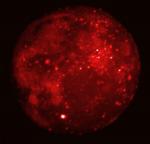 Eclipsed Moon in Infrared
10.01.1997
Last September's total lunar eclipse disappointed many observers in the Eastern and Midwestern US who were cursed with cloudy skies. However, the Midcourse Space Experiment (MSX) satellite had a spectacular view from Earth orbit and SPIRIT III, an onboard imaging infrared telescope, was used to repeatedly image the moon during the eclipse.
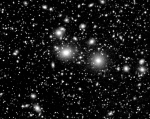 The Perseus Cluster of Galaxies
5.04.1996
Here is one of the largest objects that anyone will ever see on the sky. Each of the fuzzy blobs in the above picture is a galaxy, together making up the Perseus Cluster, one of the closest clusters of galaxies.
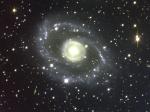 Spiral Galaxy In Centaurus
19.04.2003
Centaurus, the Centaur, is one of the most striking constellations in the southern sky. The lovely Milky Way flows through this large constellation whose celestial wonders also include the closest star to the sun, Alpha Centauri, the largest globular star cluster in our galaxy, Omega Centauri, and the closest active galaxy, Centaurus A.
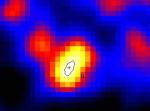 The Case of the Missing Supernova
13.04.1999
Would you notice a second Moon in the sky? About 700 years ago, light from a tremendous explosion reached Earth that should have appeared almost as bright as a full Moon. The bright spot should have lasted for weeks, yet no notation of such an occurrence has been found in historical records.
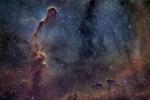 The Elephant s Trunk in IC 1396
18.10.2007
Like an illustration in a galactic Just So Story, the Elephant's Trunk Nebula winds through the emission nebula and young star cluster complex IC 1396, in the high and far off constellation of Cepheus. Of course, this cosmic elephant's trunk is over 20 light-years long.
|
January February March April May June July August September October |
|||||||||||||||||||||||||||||||||||||||||||||||||