
|
You entered: space
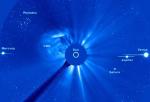 Pleiades, Planets, And Hot Plasma
24.05.2000
Bright stars of the Pleiades, four planets, and erupting solar plasma are all captured in this spectacular image from the space-based SOlar and Heliospheric Observatory (SOHO). In the foreground of the 15 degree wide field of view, a bubble of hot plasma, called a Coronal Mass Ejection (CME)
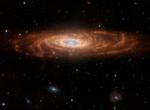 NGC 7331: A Galaxy So Inclined
1.07.2004
If our own Milky Way galaxy were 50 million light-years away with its disk inclined slightly to our line of sight, it would look a lot like large spiral galaxy NGC 7331. In fact...
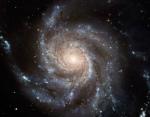 Messier 101
2.03.2006
Big, beautiful spiral galaxy M101 is one of the last entries in Charles Messier's famous catalog, but definitely not one of the least. About 170,000 light-years across, this galaxy is enormous, almost twice the size of our own Milky Way galaxy.
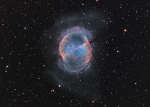 M27: Not a Comet
1.09.2011
While hunting for comets in the skies above 18th century France, astronomer Charles Messier diligently kept a list of the things he encountered that were definitely not comets. This is number 27 on his now famous not-a-comet list.
 Gamma Ray Burst, Supernova Bump
17.05.2002
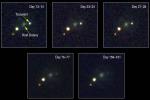
On the 21st of November 2001, satellites detected yet another burst of gamma-rays from the cosmos. While this flash of high-energy photons lasted for less than a minute, eager astronomers have been following the fading optical light from the location of the burst source ever since.
 Galaxy Cluster Lenses Farthest Known Galaxy
17.02.2004
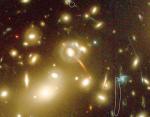
Gravity can bend light, allowing whole clusters of galaxies to act as huge telescopes. Almost all of the bright objects in this just-released Hubble Space Telescope image are galaxies in the cluster known as Abell 2218.
 Landing At The Martian South Pole
1.12.1999
The latest invader from Earth, the Mars Polar Lander (MPL) spacecraft, is scheduled to touch down on the Red Planet's surface on Friday, December 3rd. If all goes well the robotic explorer will...
 APOD: 2008 June 17- Eta Carinae and the Homunculus Nebula
17.06.2008
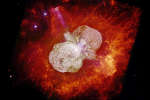
How did the star Eta Carinae create this unusual nebula? No one knows for sure. About 165 years ago, the southern star Eta Carinae mysteriously became the second brightest star in the night sky. In 20 years, after ejecting more mass than our Sun, Eta Car unexpected faded.
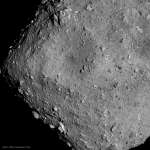 Asteroid Ryugu from Hayabusa2
22.08.2018
This big space diamond has an estimated value of over 80 billion dollars. It's only diamond in shape, though -- asteroid 162173 Ryugu is thought to be composed of mostly nickel and iron. Asteroids...
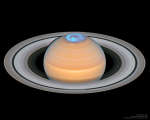 Aurora around Saturns North Pole
3.09.2018
Are Saturn's auroras like Earth's? To help answer this question, the Hubble Space Telescope and the Cassini spacecraft monitored Saturn's North Pole simultaneously during Cassini's final orbits around the gas giant in September 2017. During this time, Saturn's tilt caused its North Pole to be clearly visible from Earth.
|
January February March April May June July August September |
|||||||||||||||||||||||||||||||||||||||||||||||||