
|
You entered: space
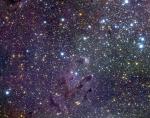 M16: Stars, Pillars and the Eagle s EGGs
3.01.2002
The Hubble Space Telescope's 1995 image of pillars of dust and gas, light-years long, within the Eagle Nebula (M16) was sensational. The three prominent pillars in that close-up visible light picture also appear...
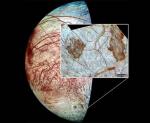 Galileo s Europa
19.09.2003
Launched in 1989 and looping through the jovian system since late 1995, the voyage of NASA's Galileo spacecraft will soon come to an end. The spacecraft has been targeted to plunge directly into Jupiter this Sunday, September 21st, at about 30 miles per second.
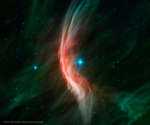 Zeta Oph: Runaway Star
5.07.2015
Like a ship plowing through cosmic seas, runaway star Zeta Ophiuchi produces the arcing interstellar bow wave or bow shock seen in this stunning infrared portrait. In the false-color view, bluish Zeta...
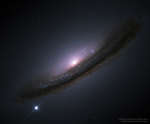 Rumors of a Dark Universe
4.08.2019
Twenty-one years ago results were first presented indicating that most of the energy in our universe is not in stars or galaxies but is tied to space itself. In the language of cosmologists, a large cosmological constant -- dark energy -- was directly implied by new distant supernova observations.
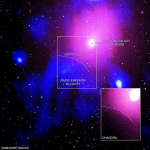 An Extreme Black Hole Outburst
11.03.2020
Astronomers believe they have now found the most powerful example of a black hole outburst yet seen in our Universe. The composite, false-color featured image is of a cluster of galaxies in the constellation of Ophiuchus, the serpent-bearer.
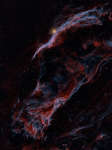 Along the Western Veil
19.09.2019
Delicate in appearance, these filaments of shocked, glowing gas, are draped across planet Earth's sky toward the constellation of Cygnus. They form the western part of the Veil Nebula. The Veil Nebula itself is a large supernova remnant, an expanding cloud born of the death explosion of a massive star.
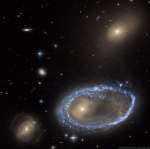 Ring Galaxy AM 0644 741
28.07.2021
The rim of the large blue galaxy at the right is an immense ring-like structure 150,000 light years in diameter composed of newly formed, extremely bright, massive stars. AM 0644-741 is known as a ring galaxy and was caused by an immense galaxy collision.
Circumpolarv2comentada1024.preview.jpg) Polaris and the Trail of Comet ZTF
Polaris and the Trail of Comet ZTF
3.02.2023
Stars trace concentric arcs around the North Celestial Pole in this three hour long night sky composite, recorded with a digital camera fixed to a tripod on January 31, near цger, Lleida, Spain. On that date Comet C/2022 E3 (ZTF) was near its northernmost declination in planet Earth's sky.
 Temperatures on Exoplanet WASP 43b
3.05.2024
A mere 280 light-years from Earth, tidally locked, Jupiter-sized exoplanet WASP-43b orbits its parent star once every 0.8 Earth days. That puts it about 2 million kilometers (less than 1/25th the orbital distance of Mercury) from a small, cool sun.
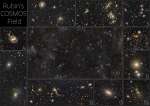 Rubin's COSMOS Field
7.08.2026
There are more than half a million galaxies in the central panel of this image from the NSF-DOE Vera C. Rubin Observatory in Chile. This is the COSMOS field, a patch of sky several times larger than the full moon, first observed by Hubble.
|
January February March April May June July August September |
|||||||||||||||||||||||||||||||||||||||||||||||||