
|
You entered: space
 Cosmic Rays and Supernova Dust
18.06.1998
Cosmic Rays are celestial high energy particles traveling at nearly the speed of light, which constantly bombard the Earth. Discovered during high altitude balloon flights in 1912 their source has been a long standing mystery.
 Galaxy and Cluster Create Four Images of Distant Supernova
8.03.2015
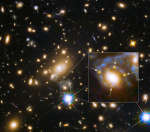
What are the unusual spots surrounding that galaxy? They are all images of the same supernova. For the first time, a single supernova explosion has been seen split into multiple images by the gravitational lens deflections of intervening masses. In this case the masses are a large galaxy and its home galaxy cluster.
 Artistic Impression: The Surface of TRAPPIST 1f
25.06.2017
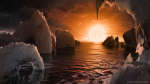
If you could stand on the surface of the newly discovered Earth-sized exoplanet TRAPPIST-1f, what would you see? Presently, no Earthling knows for sure, but the featured illustration depicts a reasoned guess based on observational data taken by NASA's Sun-orbiting Spitzer Space Telescope.
 Radio, The Big Ear, and the WOW Signal
1.05.2020
Since the early days of radio and television we have been freely broadcasting signals into space. For some time now, we have been listening too. A large radio telescope at Ohio State University known as affectionately The Big Ear was one of the first listeners.
 Dark Matter in a Simulated Universe
30.10.2021
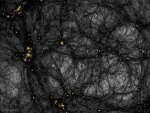
Is our universe haunted? It might look that way on this dark matter map. The gravity of unseen dark matter is the leading explanation for why galaxies rotate so fast, why galaxies orbit clusters...
 Journey to the Center of the Galaxy
20.01.1997
In Jules Verne's science fiction classic A Journey to the Center of the Earth, Professor Hardwigg and his fellow explorers encounter many strange and exciting wonders. What wonders lie at the center of our Galaxy?
 A Mysterious Streak Above Hawaii
7.02.2005
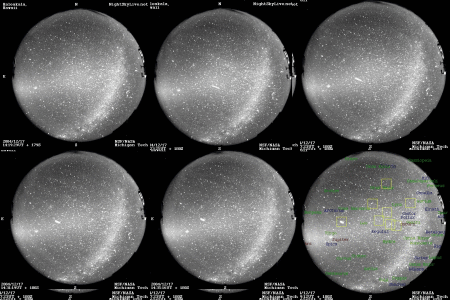
What in heavens-above was that? Not everything seen on the night sky is understood. The Night Sky Live (NSL) project keeps its global array of continuously updating web cameras (CONCAMs) always watching the night sky.
 NGC 5584: Expanding the Universe
30.03.2011
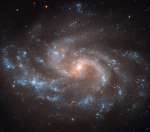
Big, beautiful NGC 5548 is more that 50,000 light-years across and lies 72 million light-years away toward the constellation Virgo. The winding spiral arms of this gorgeous island universe are loaded with luminous young star clusters and dark dust lanes. Still, for earthbound astronomers NGC 5548 is not just another pretty face-on spiral galaxy.
 NGC 2403 in Camelopardalis
23.07.2011
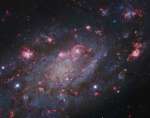
Magnificent island universe NGC 2403 stands within the boundaries of the long-necked constellation Camelopardalis. Some 10 million light-years distant and about 50,000 light-years across, the spiral galaxy also seems to have more than its fair share of giant star forming HII regions, marked by the telltale reddish glow of atomic hydrogen gas.
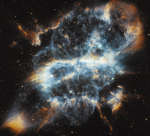 NGC 5189: An Unusually Complex Planetary Nebula
19.12.2012
Why is this nebula so complex? When a star like our Sun is dying, it will cast off its outer layers, usually into a simple overall shape. Sometimes this shape is a sphere, sometimes a double lobe, and sometimes a ring or a helix.
|
January February March April May June July August September |
|||||||||||||||||||||||||||||||||||||||||||||||||