
|
You entered: space
 Lunar Eclipses
25.04.2013
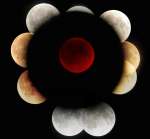
The dark, inner shadow of planet Earth is called the umbra. Shaped like a cone extending into space, it has a circular cross section and is most easily seen during a lunar eclipse. But the complete cross section is larger than the Moon's angular size in the stages of an eclipse.
 A Beautiful Trifid
5.08.2022
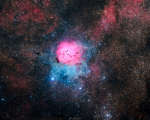
The beautiful Trifid Nebula is a cosmic study in contrasts. Also known as M20, it lies about 5,000 light-years away toward the nebula rich constellation Sagittarius. A star forming region in the plane...
 Fragments of Comet LINEAR
11.08.2000
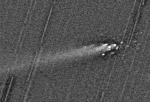
What do you call a bunch of comet fragments anyway ... a flock, a covey, a swarm? The question is definitely relevant to comet LINEAR (C/1999 S4 LINEAR) whose nucleus apparently fragmented late last month during its first trip through the inner solar system.
 SN 1006: Pieces of the Cosmic Ray Puzzle
16.10.1996
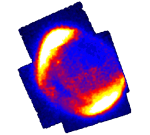
Research balloon flights conducted in 1912 by Austrian physicist Victor Hess revealed that the Earth was constantly bombarded by high energy radiation from space - which came to be called "Cosmic Rays". What are Cosmic Rays and where do they come from?
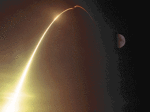 Destination: Moon
8.01.1998
Tuesday, January 6, at 9:28 p.m. EST, NASA's Lunar Prospector spacecraft climbed into the sky above Cape Canaveral Air Station riding an Athena II rocket. Representing NASA's first Moon mission since...
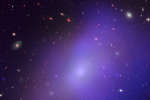 Elliptical Galaxy NGC 1132
13.02.2008
NGC 1132 is one smooth galaxy -- but how did it form? As an elliptical galaxy, NGC 1132 has little dust and gas, and few stars have formed in it recently. Although many elliptical galaxies are in clusters of galaxies, NGC 1132 appears as a large, isolated galaxy toward the constellation of the River (Eridanus).
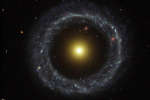 Hoags Object: A Strange Ring Galaxy
22.08.2010
Is this one galaxy or two? This question came to light in 1950 when astronomer Art Hoag chanced upon this unusual extragalactic object. On the outside is a ring dominated by bright blue stars, while near the center lies a ball of much redder stars that are likely much older.
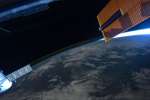 Perseid Below
10.08.2012
Denizens of planet Earth watched last year's Perseid meteor shower by looking up into the bright moonlit night sky. But this remarkable view captured on August 13, 2011 by astronaut Ron Garan looks down on a Perseid meteor.
 Hyades for the Holidays
24.12.2012
Recognized since antiquity and depicted on the shield of Achilles according to Homer, stars of the Hyades cluster form the head of the constellation Taurus the Bull. Their general V-shape is anchored by Aldebaran, the eye of the Bull and by far the constellation's brightest star.
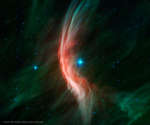 Zeta Oph: Runaway Star
8.04.2017
Like a ship plowing through cosmic seas, runaway star Zeta Ophiuchi produces the arcing interstellar bow wave or bow shock seen in this stunning infrared portrait. In the false-color view, bluish Zeta...
|
January February March April May June July August September |
|||||||||||||||||||||||||||||||||||||||||||||||||