
|
You entered: stars
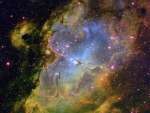 Inside the Eagle Nebula
8.02.2009
From afar, the whole thing looks like an Eagle. A closer look at the Eagle Nebula, however, shows the bright region is actually a window into the center of a larger dark shell of dust. Through this window, a brightly-lit workshop appears where a whole open cluster of stars is being formed.
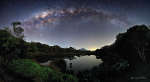 Milky Way Over Piton de lEau
25.06.2012
Sometimes, if you wait long enough for a clear and moonless night, the stars will come out with a vengeance. One such occasion occurred earlier this month at the Piton de l'Eau on Reunion Island. In the foreground, surrounded by bushes and trees, lies a water filled volcanic crater serenely reflecting starlight.
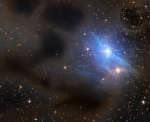 Reflections on vdB 31
11.03.2017
Riding high in the constellation of Auriga, beautiful, blue vdB 31 is the 31st object in Sidney van den Bergh's 1966 catalog of reflection nebulae. It shares this well-composed celestial still life with dark, obscuring clouds recorded in Edward E. Barnard's 1919 catalog of dark markings in the sky.
 The Light, the Dark, and the Dusty
10.01.2024
This colorful skyscape spans about three full moons across nebula rich starfields along the plane of our Milky Way Galaxy toward the royal northern constellation Cepheus. Near the edge of the region's massive...
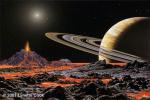 The 47 Ursae Majoris System
17.08.2001
Watching and waiting, astronomers have uncovered the presence of more than 70 planets orbiting stars other than the Sun. So far almost all these extrasolar planets have crazy elongated orbits, lie uncomfortably close to their parent stars, or are found in bizarre, inhospitable systems.
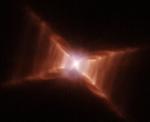 Rungs of the Red Rectangle
13.05.2004
A distinctive X-shape and ladder-like rungs appear in this Hubble Space Telescope image of the intriguing Red Rectangle Nebula. The dusty cosmic cloud was originally identified as a strong source of infrared radiation and is now believed to contain icy dust grains and hydrocarbon molecules formed in the cool outflow from an aging central star.
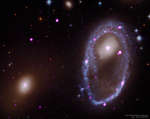 Cosmic Collision Forges Galactic Ring
17.09.2018
How could a galaxy become shaped like a ring? The rim of the blue galaxy pictured on the right is an immense ring-like structure 150,000 light years in diameter composed of newly formed, extremely bright, massive stars.
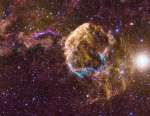 Sibling Supernova Remnants
2.07.2026
What happens when one of the stars in a binary goes supernova? This image combines visible (yellow), ultraviolet (purple) and infrared light (cyan, red and orange) to show two supernova remnants and their surrounding environment, about 6,000 light-years away. The younger one is the well-known Jellyfish Nebula in the center (mostly in yellow).
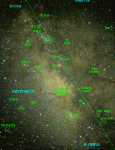 The Annotated Galactic Center
29.12.2001
The sky toward the center of our Galaxy is filled with a wide variety of celestial wonders. Many are easily visible with binoculars. Constellations near the galactic center include Sagittarius, Libra, Scorpius, Scutum, and Ophiuchus. Nebulae include Messier Objects M8, M16, M17, M20 and the Pipe Nebula.
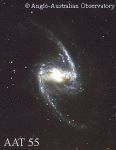 Barred Spiral Galaxy NGC 1365
19.05.1997
Many spiral galaxies have bars across their centers. Even our own Milky Way Galaxy is thought to have a bar, but perhaps not so prominent as the one in NGC 1365, shown above. The persistence and motion of the bar imply relatively massive spiral arms.
|
January February March April May June July August September |
|||||||||||||||||||||||||||||||||||||||||||||||||