
|
You entered: stars
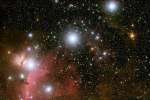 Orion s Belt
10.02.2009
Alnitak, Alnilam, and Mintaka, are the bright bluish stars from east to west (left to right) along the diagonal in this gorgeous cosmic vista. Otherwise known as the Belt of Orion, these three blue supergiant stars are hotter and much more massive than the Sun.
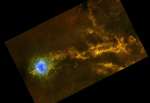 Herschel s Cocoon
19.08.2011
In this remarkable infrared skyscape of interstellar clouds adrift in the high flying constellation Cygnus, the eye is drawn to the Cocoon Nebula. Also known as IC5146, the dusty star forming region is shown...
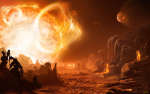 A Dangerous Sunrise on Gliese 876d
29.04.2012
On planet Gliese 876d, sunrises might be dangerous. Although nobody really knows what conditions are like on this close-in planet orbiting variable red dwarf star Gliese 876, the above artistic illustration gives one impression.
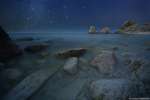 Andromeda on the Rocks
27.09.2013
How far can you see? The Andromeda Galaxy 2.5 million light years away is the most distant object easily seen by the unaided eye. Other apparent denizens of the night sky, stars, clusters...
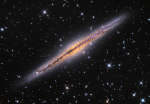 NGC 891 Edge On
11.10.2013
This sharp cosmic portrait features NGC 891. The spiral galaxy spans about 100 thousand light-years and is seen almost exactly edge-on from our perspective. In fact, about 30 million light-years distant in the constellation Andromeda, NGC 891 looks a lot like our Milky Way.
 NGC 7331 Close Up
7.02.2018
Big, beautiful spiral galaxy NGC 7331 is often touted as an analog to our own Milky Way. About 50 million light-years distant in the northern constellation Pegasus, NGC 7331 was recognized early on as a spiral nebula and is actually one of the brighter galaxies not included in Charles Messier's famous 18th century catalog.
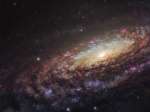 NGC 7331 Close Up
7.02.2020
Big, beautiful spiral galaxy NGC 7331 is often touted as an analog to our own Milky Way. About 50 million light-years distant in the northern constellation Pegasus, NGC 7331 was recognized early on as a spiral nebula and is actually one of the brighter galaxies not included in Charles Messier's famous 18th century catalog.
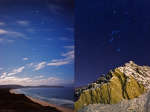 Scenes from Two Hemispheres
15.01.2010
The stars of a summer night on the left and the winter night sky on the right are the same stars. In fact, both pictures were taken in late December and have similar fields of view.
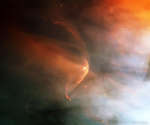 LL Orionis: When Cosmic Winds Collide
22.05.2016
What created this great arc in space? This arcing, graceful structure is actually a bow shock about half a light-year across, created as the wind from young star LL Orionis collides with the Orion Nebula flow.
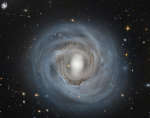 Anemic Spiral NGC 4921 from Hubble
25.11.2013
How far away is spiral galaxy NGC 4921? Although presently estimated to be about 310 million light years distant, a more precise determination could be coupled with its known recession speed to help humanity better calibrate the expansion rate of the entire visible universe.
|
January February March April May June July August September |
|||||||||||||||||||||||||||||||||||||||||||||||||