
|
You entered: stars
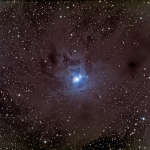 A Dusty Iris Nebula
10.06.2009
These clouds of interstellar dust and gas have blossomed 1,300 light-years away in the fertile star fields of the constellation Cepheus. Sometimes called the Iris Nebula and dutifully cataloged as NGC 7023, this is not the only nebula in the sky to evoke the imagery of flowers.
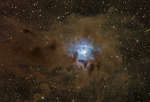 A Dusty Iris Nebula
4.08.2011
These clouds of interstellar dust and gas have blossomed 1,300 light-years away in the fertile star fields of the constellation Cepheus. Sometimes called the Iris Nebula and dutifully cataloged as NGC 7023, this is not the only nebula in the sky to evoke the imagery of flowers.
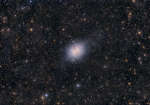 Peculiar Elliptical Galaxy Centaurus A
30.06.2014
What's happened to the center of this galaxy? Unusual and dramatic dust lanes run across the center of elliptical galaxy Centaurus A. These dust lanes are so thick they almost completely obscure the galaxy's center in visible light.
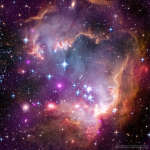 NGC 602 and Beyond
24.03.2018
Near the outskirts of the Small Magellanic Cloud, a satellite galaxy some 200 thousand light-years distant, lies 5 million year young star cluster NGC 602. Surrounded by natal gas and dust...
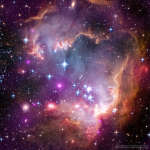 NGC 602 and Beyond
11.01.2020
Near the outskirts of the Small Magellanic Cloud, a satellite galaxy some 200 thousand light-years distant, lies 5 million year young star cluster NGC 602. Surrounded by natal gas and dust...
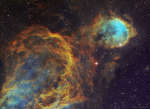 WR32 and Interstellar Clouds in Carina
8.02.2021
Stars can be like artists. With interstellar gas as a canvas, a massive and tumultuous Wolf-Rayet star has created the picturesque ruffled half-circular filaments called WR32, on the image left. Additionally, the winds...
 Planetary Nebula Abell 7
7.03.2025
Very faint planetary nebula Abell 7 is about 1,800 light-years distant. It lies just south of Orion in planet Earth's skies toward the constellation Lepus, The Hare. Surrounded by Milky Way stars...
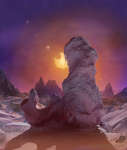 APOD: 2023 February 1 Б The Seventh World of Trappist 1
1.02.2023
Seven worlds orbit the ultracool dwarf star TRAPPIST-1. A mere 40 light-years away, many of the exoplanets were discovered in 2016 using the Transiting Planets and Planetesimals Small Telescope (TRAPPIST) located in the Atlas Mountains of Morocco, and later confirmed with telescope including NASA's Spitzer Space Telescope.
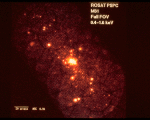 The X-ray Sources of M31
31.12.1995
Just like our own Milky Way Galaxy, the nearest major galaxy M31 has many star systems spewing high energy radiation. High energy X-radiation is visible to certain satellites in Earth orbit such as ROSAT - which took the above picture.
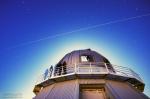 ISS Over Mont Megantic Observatory
18.08.2007
On August 1st, a time exposure created this surreal view that looks up into the early morning sky over southern Quebec. Only the light from a nearly Full Moon brightens the sky and highlights the dome of the 1.6 meter telescope at Mont-Megantic Observatory.
|
January February March April May June July August September |
|||||||||||||||||||||||||||||||||||||||||||||||||