
|
You entered: stars
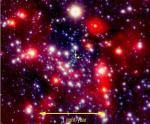 At the Center of the Milk Way
23.10.2005
At the center of our Milky Way Galaxy lies a black hole with over 2 million times the mass of the Sun. Once a controversial claim, this astounding conclusion is now virtually inescapable and based on observations of stars orbiting very near the galactic center.
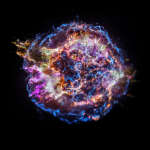 Recycling Cassiopeia A
27.12.2017
Massive stars in our Milky Way Galaxy live spectacular lives. Collapsing from vast cosmic clouds, their nuclear furnaces ignite and create heavy elements in their cores. After a few million years, the enriched material is blasted back into interstellar space where star formation can begin anew.
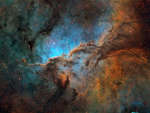 Shaping NGC 6188
16.07.2010
Dark shapes with bright edges winging their way through dusty NGC 6188 are tens of light-years long. The emission nebula is found near the edge of an otherwise dark large molecular cloud in the southern constellation Ara, about 4,000 light-years away.
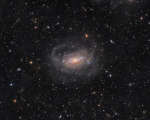 Curly Spiral Galaxy M63
3.12.2020
A bright spiral galaxy of the northern sky, Messier 63 is nearby, about 30 million light-years distant toward the loyal constellation Canes Venatici. Also cataloged as NGC 5055, the majestic island universe is nearly 100,000 light-years across, about the size of our own Milky Way.
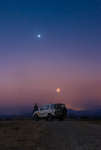 Love and War by Moonlight
15.07.2021
Venus, named for the Roman goddess of love, and Mars, the war god's namesake, come together by moonlight in this serene skyview, recorded on July 11 from Lualaba province, Democratic Republic of Congo, planet Earth.
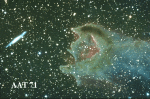 CG4: A Ruptured Cometary Globule
4.10.1995
The odd looking "creature" to the right of center in the above photo is a gas cloud known as a cometary globule. This globule, however, has ruptured. Cometary globules are typically characterized by dusty heads and elongated tails.
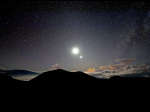 Above the Clouds
23.04.2008
From the windswept peak of Mauna Kea, on the Big Island of Hawaii, your view of the world at night could look like this. At an altitude of about 13,500 feet, the mountain top is silhouetted in the stunning skyscape recorded near dusk in early December of 2005.
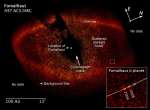 Fomalhaut b
13.11.2008
Fomalhaut (sounds like "foam-a-lot") is a bright, young, star, a short 25 light-years from planet Earth in the direction of the constellation Piscis Austrinus. In this sharp composite from the Hubble Space Telescope, Fomalhaut...
 APOD: 2023 October 24 Б Arp 87: Merging Galaxies from Hubble
23.10.2023
This dance is to the death. As these two large galaxies duel, a cosmic bridge of stars, gas, and dust currently stretches over 75,000 light-years and joins them. The bridge itself is strong evidence that these two immense star systems have passed close to each other and experienced violent tides induced by mutual gravity.
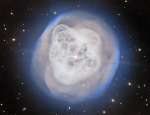 APOD: 2026 May 28 Б NGC 1514: The Crystal Ball Nebula
27.05.2026
What do you see in this crystal ball? The featured image shows NGC 1514, known as the Crystal Ball Nebula, observed by the Gemini North telescope on Maunakea, in Hawai'i. NGC 1514 is 1,500 light-years away and was discovered by William Herschel in 1790.
|
January February March April May June July August September |
|||||||||||||||||||||||||||||||||||||||||||||||||