
|
You entered: stars
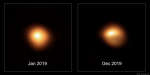 The Changing Surface of Fading Betelgeuse
17.02.2020
Besides fading, is Betelgeuse changing its appearance? Yes. The famous red supergiant star in the familiar constellation of Orion is so large that telescopes on Earth can actually resolve its surface -- although just barely.
 APOD: 2025 September 18 Б Comet C/2025 R2 SWAN
18.09.2025
A new visitor from the outer Solar System, comet C/2025 R2 (SWAN) also known as SWAN25B was only discovered late last week, on September 11. That's just day before the comet reached perihelion, its closest approach to the Sun.
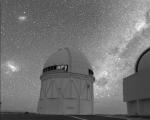 A Cerro Tololo Sky
14.05.2001
High atop a Chilean mountain lies one of the premier observatories of the southern sky: Cerro Tololo. Pictured above is one of the premier telescopes of the Cerro Tololo Inter-American Observatory (CTIO) and of the past quarter-century: the 4-meter Blanco Telescope.
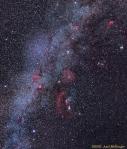 Clusters and Nebulae of the Hexagon
4.04.2003
At first, the bright stars of the large asterism known as the (northern) Winter Hexagon might be hard to pick out in this gorgeous deep sky mosaic from December 2002. But placing your cursor...
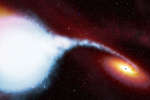 Black Hole Candidate Cygnus X 1
11.08.2008
Is that a black hole? Quite possibly. The Cygnus X-1 binary star system contains one of the best candidates for a black hole. The system was discovered because it is one of the brightest...
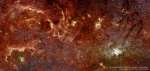 The Galactic Core in Infrared
17.01.2015
What's happening at the center of our Milky Way Galaxy? To help find out, the orbiting Hubble and Spitzer space telescopes have combined their efforts to survey the region in unprecedented detail in infrared light. Milky Way's center because visible light is more greatly obscured by dust.
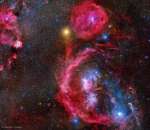 A 212 Hour Exposure of Orion
29.03.2020
The constellation of Orion is much more than three stars in a row. It is a direction in space that is rich with impressive nebulas. To better appreciate this well-known swath of sky, an extremely long exposure was taken over many clear nights in 2013 and 2014.
 Three Worlds for TRAPPIST 1
7.05.2016
Three new found worlds orbit the ultracool dwarf star TRAPPIST-1, a mere 40 light-years away. Their transits were first detected by the Belgian robotic TRAnsiting Planets and Planetesimals Small Telescope, TRAPPIST, at ESO's La Silla Observatory in Chile. The newly discovered exoplanets are all similar in size to Earth.
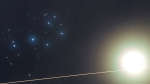 The Traffic in Taurus
3.04.2020
There's a traffic jam in Taurus lately. On April 1, this celestial frame from slightly hazy skies over Tapiobicske, Hungary recorded an impressive pile up toward the zodiacal constellation of the Bull and the Solar System's ecliptic plane.
 M100: A Grand Design Spiral Galaxy
2.05.2024
Majestic on a truly cosmic scale, M100 is appropriately known as a grand design spiral galaxy. The large galaxy of over 100 billion stars has well-defined spiral arms, similar to our own Milky Way.
|
January February March April May June July August September |
|||||||||||||||||||||||||||||||||||||||||||||||||