
|
You entered: dust
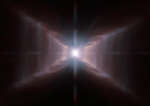 The Red Rectangle Nebula from Hubble
14.06.2010
How was the unusual Red Rectangle nebula created? At the nebula's center is a young binary star system that surely powers the nebula but does not, as yet, explain its colors. The unusual...
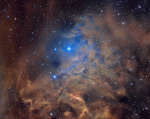 AE Aurigae and the Flaming Star Nebula
7.01.2013
AE Aurigae is called the flaming star. The surrounding nebula IC 405 is named the Flaming Star Nebula and the region seems to harbor smoke, but there is no fire. Fire, typically defined...
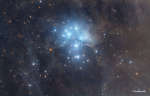 M45: The Pleiades Star Cluster
19.10.2016
Have you ever seen the Pleiades star cluster? Even if you have, you probably have never seen it as dusty as this. Perhaps the most famous star cluster on the sky, the bright stars of the Pleiades can be seen without binoculars even from the heart of a light-polluted city.
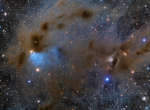 Young Stars and Dusty Nebulae in Taurus
30.03.2017
This complex of dusty nebulae lingers along the edge of the Taurus molecular cloud, a mere 450 light-years distant. Stars are forming on the cosmic scene. Composed from almost 40 hours of image data...
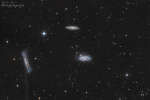 The Leo Trio
18.04.2019
This group is popular in the northern spring. Famous as the Leo Triplet, the three magnificent galaxies gather in one field of view. Crowd pleasers when imaged with even modest telescopes, they can be introduced individually as NGC 3628 (left), M66 (bottom right), and M65 (top).
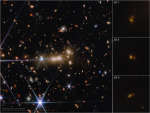 APOD: 2023 January 18 Б MACS0647: Gravitational Lensing of the Early Universe by Webb
18.01.2023
Gravitational lensing by the galaxy cluster MACS0647 -- in which the massive foreground cluster distorts and lenses the light emitted by distant background galaxies along the line of sight Б is on vivid display here in this recent multi-color infrared image from the James Webb Space Telescope (JWST).
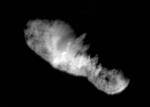 Comet Borrelly's Nucleus
26.09.2001
What does a comet nucleus look like? To answer this question, NASA controllers drove an aging probe through the hostile environs of a distant comet, expecting that even if comet fragments disabled the spacecraft, it would be worth the risk. The probe, Deep Space 1, survived.
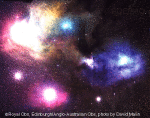 The Colorful Clouds of Rho Ophiuchi
12.03.1996
The many spectacular colors of the Rho Ophiuchi (oh'-fee-yu-kee) clouds highlight the many processes that occur there. The blue regions shine primarily by reflected light. Blue light from the star rho Ophiuchi and nearby stars reflects more efficiently off this portion of the nebula than red light.
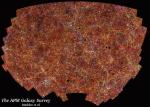 Two Million Galaxies
11.06.2003
Our universe is filled with galaxies. Galaxies -- huge conglomerations of stars, gas, dust -- and mysterious dark matter are the basic building blocks of the large-scale universe. Although distant galaxies move away from each other...
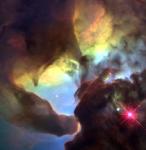 Twistin' by the Lagoon
23.01.1997
The awesome spectacle of starbirth produces extreme stellar winds and intense energetic starlight -- bombarding dusty molecular clouds inside the Lagoon Nebula (M8). At least two long funnel shaped clouds, each roughly half a light-year long, have apparently been formed by this activity.
|
January February March April May June July August September |
|||||||||||||||||||||||||||||||||||||||||||||||||