
|
You entered: dust
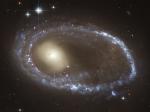 Ring Galaxy AM 0644 741 from Hubble
22.10.2005
How could a galaxy become shaped like a ring? The rim of the blue galaxy pictured on the right is an immense ring-like structure 150,000 light years in diameter composed of newly formed, extremely bright, massive stars.
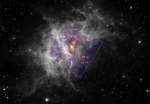 Young Star Cluster Westerlund 2
31.01.2008
Dusty stellar nursery RCW 49 surrounds young star cluster Westerlund 2 in this remarkable composite skyscape from beyond the visible spectrum of light. Infrared data from the Spitzer Space Telescope is shown in black...
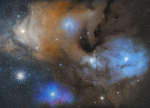 The Colorful Clouds of Rho Ophiuchi
3.12.2013
The many spectacular colors of the Rho Ophiuchi (oh'-fee-yu-kee) clouds highlight the many processes that occur there. The blue regions shine primarily by reflected light. Blue light from the star Rho Ophiuchi and nearby stars reflects more efficiently off this portion of the nebula than red light.
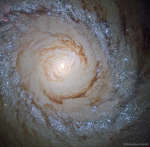 Starburst Galaxy M94 from Hubble
31.07.2022
Why does this galaxy have a ring of bright blue stars? Beautiful island universe Messier 94 lies a mere 15 million light-years distant in the northern constellation of the Hunting Dogs (Canes Venatici).
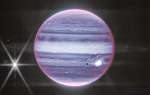 APOD: 2025 April 2 Б Jupiter and Ring in Infrared from Webb
2.04.2025
Why does Jupiter have rings? Jupiter's main ring was discovered in 1979 by NASA's passing Voyager 1 spacecraft, but its origin was then a mystery. Data from NASA's Galileo spacecraft that...
 APOD: 2025 August 27 Б WISPIT 2b: Exoplanet Carves Gap in Birth Disk
27.08.2025
That yellow spot -- what is it? It's a young planet outside our Solar System. The featured image from the Very Large Telescope in Chile surprisingly captures a distant scene much like our own Solar System's birth, some 4.5 billion years ago.
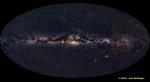 All-Sky Panorama
2.02.2001
This quite stunning panorama of the entire sky is a mosaic of 51 wide-angle photographs. Made over a three year period from locations in California (USA), South Africa, and Germany, the individual pictures were digitized and stitched together to create an apparently seamless 360 by 180 degree view.
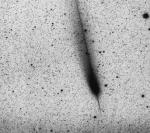 Hale Bopp: A Continuing Tail
20.02.1998
Where is Hale-Bopp now? The Great Comet of 1997, one of the largest and most active comets ever, is outbound about 400 million miles from the sun. Too faint for viewing without telescopes or binoculars, Hale-Bopp is presently positioned in the very southerly constellation of Pictor.
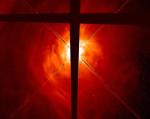 AB Aurigae: How To Make Planets
11.06.1999
This enhanced Hubble Space Telescope image shows in remarkable detail the inner portion of the disk of dust and gas surrounding the star AB Aurigae. Knots of material, visible here for the first time...
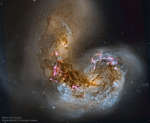 Spiral Galaxy NGC 4038 in Collision
23.05.2018
This galaxy is having a bad millennium. In fact, the past 100 million years haven't been so good, and probably the next billion or so will be quite tumultuous. Visible toward the lower...
|
January February March April May June July August September |
|||||||||||||||||||||||||||||||||||||||||||||||||