
|
You entered: dust
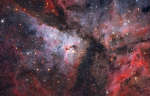 The Great Carina Nebula
27.12.2018
A jewel of the southern sky, the Great Carina Nebula, also known as NGC 3372, spans over 300 light-years, one of our galaxy's largest star forming regions. Like the smaller, more northerly Great...
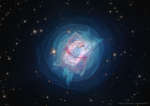 Bright Planetary Nebula NGC 7027 from Hubble
30.06.2020
What created this unusual planetary nebula? NGC 7027 is one of the smallest, brightest, and most unusually shaped planetary nebulas known. Given its expansion rate, NGC 7027 first started expanding, as visible from Earth, about 600 years ago.
 The Leo Trio
21.03.2024
This popular group leaps into the early evening sky around the March equinox and the northern hemisphere spring. Famous as the Leo Triplet, the three magnificent galaxies found in the prominent constellation Leo gather here in one astronomical field of view.
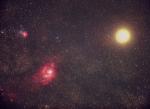 Messiers and Mars
28.06.2003
A telescopic tour of the constellation Sagittarius offers the many bright clusters and nebulae of dimensioned space in a starscape surrounding the galactic center. This gorgeous color deep-sky photograph visits two such lovely sights, cataloged by the 18th century cosmic tourist Charles Messier as M8 and M20.
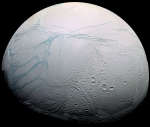 Fresh Tiger Stripes on Saturn's Enceladus
28.06.2009
Do underground oceans vent through the tiger stripes on Saturn's moon Enceladus? Long features dubbed tiger stripes are known to be spewing ice from the moon's icy interior into space, creating a cloud of fine ice particles over the moon's South Pole and creating Saturn's mysterious E-ring.
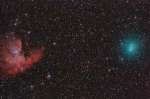 Pacman and Hartley
7.10.2010
Touring the solar system with a 6 year orbital period, small comet Hartley 2 (103/P Hartley) will make its closest approach to planet Earth on October 20 and its closest approach to the Sun on October 28. It may become a naked-eye comet, just visible in clear, dark skies.
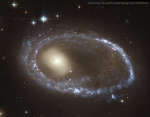 Ring Galaxy AM 0644 741 from Hubble
19.04.2015
How could a galaxy become shaped like a ring? The rim of the blue galaxy pictured on the right is an immense ring-like structure 150,000 light years in diameter composed of newly formed, extremely bright, massive stars.
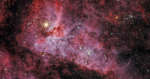 The Great Carina Nebula
27.05.2016
A jewel of the southern sky, the Great Carina Nebula, also known as NGC 3372, spans over 300 light-years, one of our galaxy's largest star forming regions. Like the smaller, more northerly Great...
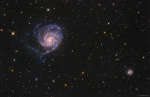 The View Toward M101
4.05.2018
Big, beautiful spiral galaxy M101 is one of the last entries in Charles Messier's famous catalog, but definitely not one of the least. About 170,000 light-years across, this galaxy is enormous, almost twice the size of our own Milky Way galaxy.
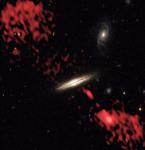 192: The Wrong Galaxy
14.01.2003
Centered above is distant galaxy 0313-192, some one billion light-years away. Radio emission from the galaxy has been mapped by the National Radio Astronomy Observatory's Very Large Array and is shown in red, composited with a visible light image from the Hubble Space Telescope's new Advanced Camera for Surveys.
|
January February March April May June July August September |
|||||||||||||||||||||||||||||||||||||||||||||||||