
|
You entered: dust
 Airglow, Gegenschein, and Milky Way
20.04.2013
As far as the eye could see, it was a dark night at Las Campanas Observatory in the southern Atacama desert of Chile. But near local midnight on April 11, this mosaic of 3 minute long exposures revealed a green, unusually intense, atmospheric airglow stretching over thin clouds.
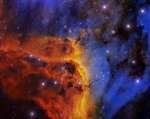 IC 5067 in the Pelican Nebula
26.05.2016
The prominent ridge of emission featured in this sharp, colorful skyscape is cataloged as IC 5067. Part of a larger emission nebula with a distinctive shape, popularly called The Pelican Nebula, the ridge spans about 10 light-years following the curve of the cosmic pelican's head and neck.
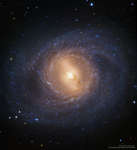 M95: Spiral Galaxy with an Inner Ring
29.05.2019
Why do some spiral galaxies have a ring around the center? First and foremost, M95 is one of the closer examples of a big and beautiful barred spiral galaxy. Visible in the featured combination...
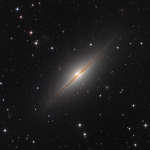 NGC 7814: Little Sombrero with Supernova
22.07.2021
Point your telescope toward the high flying constellation Pegasus and you can find this expanse of Milky Way stars and distant galaxies. NGC 7814 is centered in the pretty field of view that would almost be covered by a full moon.
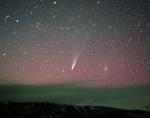 Ikeya Zhang: Comet Over Colorado
4.04.2002
Comet Ikeya-Zhang ("ee-KAY-uh JONG") has become a most photogenic comet. This lovely early evening view of the comet in Rocky Mountain skies looks northwest over ridges and low clouds. The time exposure was recorded on March 31st from an 8,000 foot elevation near Yampa, Colorado, USA.
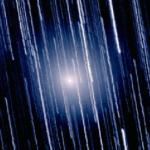 Tempel Tuttle: The Leonid Comet
16.11.2002
Star trails streak this composite time exposure of comet Tempel-Tuttle recorded by Tim Puckett on January 26, 1998. Then passing through the inner solar system on its 33 year orbit around the Sun, Tempel-Tuttle brightened unexpectedly, but binoculars or small telescopes were still required to visually observe it.
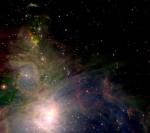 UKIRT: Aloha Orion
6.01.2005
At the edge of a dense molecular cloud, filaments of gas, cosmic dust, and a multitude of young stars beckon in this penetrating image of the Orion Nebula. Alluring structures in the well-known star...
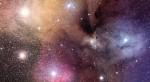 The Colorful Clouds of Rho Ophiuchi
9.07.2005
The many spectacular colors of the Rho Ophiuchi (oh'-fee-yu-kee) clouds highlight the many processes that occur there. The blue regions shine primarily by reflected light. Blue light from the star Rho Ophiuchi and nearby stars reflects more efficiently off this portion of the nebula than red light.
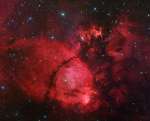 The Color of IC 1795
13.10.2011
This sharp cosmic portrait features glowing gas and obscuring dust clouds in IC 1795, a star forming region in the northern constellation Cassiopeia. Also cataloged as NGC 896, the nebula's remarkable details, shown...
 IC 59 and IC 63 in Cassiopeia
3.11.2011
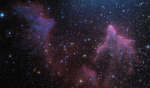
These bright rims and flowing shapes suggest to some melting ice cream on a cosmic scale. Looking toward the constellation Cassiopeia, the colorful (zoomable) skyscape features the swept back, comet-shaped clouds IC 59 (left) and IC 63.
|
January February March April May June July August September |
|||||||||||||||||||||||||||||||||||||||||||||||||