
|
You entered: dust
 APOD: 2024 August 28 Б Tulip Nebula and Black Hole Cygnus X 1
28.08.2024
When can you see a black hole, a tulip, and a swan all at once? At night -- if the timing is right, and if your telescope is pointed in the right direction. The complex and beautiful Tulip Nebula blossoms about 8,000 light-years away toward the constellation of Cygnus the Swan.
 APOD: 2025 June 15 Б Two Worlds One Sun
15.06.2025
How different does sunset appear from Mars than from Earth? For comparison, two images of our common star were taken at sunset, one from Earth and one from Mars. These images were scaled to have the same angular width and are featured here side-by-side.
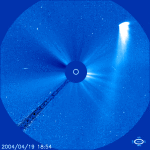 Comet Bradfield Passes the Sun
19.04.2004
Right now, Comet Bradfield is passing the Sun. The above image, the latest taken in the direction of the Sun by the SOHO LASCO instrument, shows the comet and its dust tail as the elongated white streak. The Sun would normally be seen in the very center but has been blocked from view.
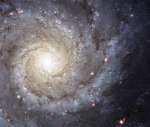 M74: The Perfect Spiral
11.08.2013
If not perfect, then this spiral galaxy is at least one of the most photogenic. An island universe of about 100 billion stars, 32 million light-years away toward the constellation Pisces, M74 presents a gorgeous face-on view.
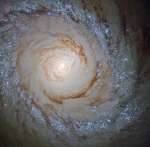 Starburst Galaxy Messier 94
23.10.2015
Beautiful island universe Messier 94 lies a mere 15 million light-years distant in the northern constellation of the hunting dogs, Canes Venatici. A popular target for earth-based astronomers, the face-on spiral galaxy is about 30,000 light-years across, with spiral arms sweeping through the outskirts of its broad disk.
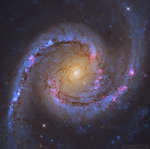 NGC 1566: The Spanish Dancer Spiral Galaxy
2.07.2019
If not perfect, then this spiral galaxy is at least one of the most photogenic. An island universe containing billions of stars and situated about 40 million light-years away toward the constellation of the Dolphinfish (Dorado), NGC 1566 presents a gorgeous face-on view.
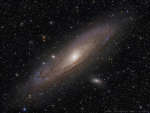 Andromeda Island Universe
30.04.2020
The most distant object easily visible to the unaided eye is M31, the great Andromeda Galaxy some two and a half million light-years away. But without a telescope, even this immense spiral galaxy - spanning over 200,000 light years - appears as a faint, nebulous cloud in the constellation Andromeda.
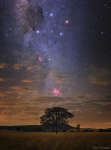 Carina in Perspective
5.05.2020
You need to be in the south, looking south, to see such a sky. And only then if you're lucky. Just above the picturesque tree is the impressive Carina Nebula, one of the few nebulas in the sky that is visible to the unaided eye.
 APOD: 2024 May 1 Б IC 1795: The Fishhead Nebula
1.05.2024
To some, this nebula looks like the head of a fish. However, this colorful cosmic portrait really features glowing gas and obscuring dust clouds in IC 1795, a star forming region in the northern constellation Cassiopeia.
 APOD: 2025 May 7 Б Galaxy Wars: M81 versus M82
7.05.2025
In the upper left corner, surrounded by blue arms and dotted with red nebulas, is spiral galaxy M81. In the lower right corner, marked by a light central line and surrounded by red glowing gas, is irregular galaxy M82.
|
January February March April May June July August September |
|||||||||||||||||||||||||||||||||||||||||||||||||