
|
You entered: motion
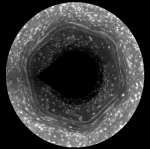 Saturns Hexagon Comes to Light
14.12.2009
Believe it or not, this is the North Pole of Saturn. It is unclear how an unusual hexagonal cloud system that surrounds Saturn's north pole was created, keeps its shape, or how long it will last.
 A MACHO View of Galactic Dark Matter
2.02.1996
What is our Galaxy made of? Stellar motions indicate there is much more mass than just stars and gas. Photographs like the two shown above may be yielding a clue about the dark matter, however.
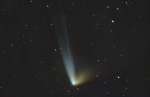 Comet Tails and Star Trails
21.07.2015
After grazing the western horizon on northern summer evenings Comet PanSTARRS (also known as C/2014 Q1) climbed higher in southern winter skies. A visitor to the inner Solar System discovered in August 2014 by the prolific panSTARRS survey, the comet was captured here on July 17.
 Jupiter Cloud Animation from Juno
21.05.2018
How do Jupiter's clouds move? To help find out, images taken with NASA's Juno spacecraft during its last pass near Jupiter have been analyzed and digitally extrapolated into a time-lapse video.
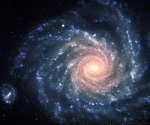 Grand Spiral Galaxy NGC 1232
26.12.2017
Galaxies are fascinating not only for what is visible, but for what is invisible. Grand spiral galaxy NGC 1232, captured in detail by one of the Very Large Telescopes, is a good example.
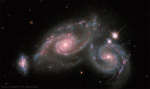 APOD: 2023 January 23 Б The Colliding Spiral Galaxies of Arp 274
23.01.2023
Two galaxies are squaring off in Virgo and here are the latest pictures. When two galaxies collide, the stars that compose them usually do not. This is because galaxies are mostly empty space and, however bright, stars only take up only a small fraction of that space.
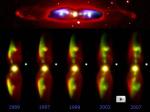 Monitoring M2-9
18.06.2007
Exploring the myriad shapes found in the cosmic zoo of planetary nebulae, some astronomers have focused on the intriguing example of M2-9. About 2,100 light-years away and over one light-year across, M2-9 is known as a twin jet or butterfly nebula in reference to its striking bipolar symmetry.
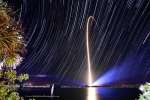 Rocket Streak and Star Trails
30.01.2014
Fixed to a tripod and looking east across the Kennedy Space Center's Turn Basin, a camera captured these star trails as a series of short exposures over a three hour period on the evening of January 23rd.
 Firing Lasers to Tame the Sky
10.02.2021
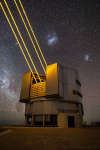
Why do stars twinkle? Our atmosphere is to blame as pockets of slightly off-temperature air, in constant motion, distort the light paths from distant astronomical objects. Atmospheric turbulence is a problem for astronomers because it blurs the images of the sources they want to study.
 Voyager at 90 AU
20.11.2003
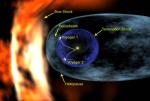
Launched in 1977, Voyager 1 is now about 12 light-hours or 90 astronomical units (AU) from the Sun, making this spacecraft humanity's most distant ambassador to the cosmos. Well beyond the orbits...
|
January February March April May June July August September |
|||||||||||||||||||||||||||||||||||||||||||||||||