
|
You entered: motion
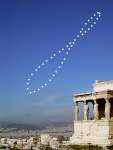 Analemma Over the Porch of Maidens
21.12.2008
If you took a picture of the Sun at the same time each day, would it remain in the same position? The answer is no, and the shape traced out by the Sun over the course of a year is called an analemma.
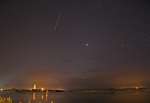 Shuttle and Meteor
14.08.2009
This early morning skyscape was captured last week on August 4th, looking northeast across calm waters in the Turn Basin at NASA's Kennedy Space Center. In a striking contrast in motion, the space...
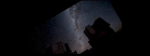 Earth Rotating Under Very Large Telescopes
1.06.2011
Why is the Earth moving in the above video? Most time lapse videos of the night sky show the stars and sky moving above a steady Earth. Here, however, the frames have been digitally rotated so that it is the stars that stay (approximately) steady, and the Earth that moves beneath them.
 The Solar Eclipse Analemma Project
20.03.2025
Recorded from 2024 March 10, to 2025 March 1, this composited series of images reveals a pattern in the seasonal drift of the Sun's daily motion through planet Earth's sky. Known...
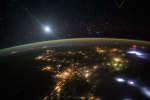 Sprites from Space
21.08.2015
An old Moon and the stars of Orion rose above the eastern horizon on August 10. The Moon's waning crescent was still bright enough to be overexposed in this snapshot taken from another large satellite of planet Earth, the International Space Station.
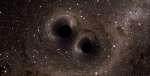 Two Black Holes Merge
12.02.2016
Just press play to watch two black holes merge. Inspired by the first direct detection of gravitational waves by LIGO, this simulation video plays in slow motion but would take about one third of a second if run in real time.
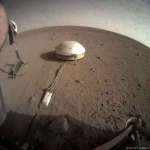 SEIS: Listening for Marsquakes
4.06.2019
If you put your ear to Mars, what would you hear? To find out, and to explore the unknown interior of Mars, NASA's Insight Lander deployed SEIS late last year, a sensitive seismometer that can detect marsquakes.
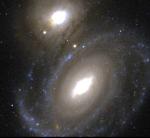 Galaxies Away
21.08.1999
This striking pair of galaxies is far, far away ... about 350 million light-years from Earth. Cataloged as AM0500-620, the pair is located in the southern constellation Dorado. The background elliptical and foreground spiral galaxy are representative of two of the three major classes of galaxies which inhabit our Universe.
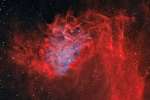 AE Aurigae and the Flaming Star Nebula
11.03.2011
AE Aurigae is the bright star below and left of center in this evocative portrait of IC 405, also known as the Flaming Star Nebula. Embedded in the cosmic cloud, the hot, variable O-type star energizes the glow of hydrogen along convoluted filaments of atomic gas, its blue starlight scattered by interstellar dust.
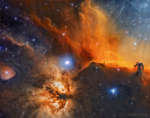 The Horsehead and Flame Nebulas
3.11.2021
The Horsehead Nebula is one of the most famous nebulae on the sky. It is visible as the dark indentation to the orange emission nebula at the far right of the featured picture. The horse-head feature is dark because it is really an opaque dust cloud that lies in front of the bright emission nebula.
|
January February March April May June July August September |
|||||||||||||||||||||||||||||||||||||||||||||||||