
|
You entered: motion
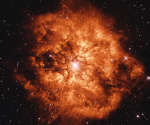 Wolf Rayet Star 124: Stellar Wind Machine
1.07.2014
Some stars explode in slow motion. Rare, massive Wolf-Rayet stars are so tumultuous and hot that they slowly disintegrating right before our telescopes. Glowing gas globs each typically over 30 times more massive than the Earth are being expelled by violent stellar winds.
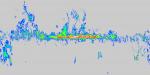 Milky Way Molecule Map
30.04.1997
Where are the Milky Way's gas clouds and where are they going? Stars form in gas clouds, and the motion of gas clouds tell us about the size and rotation speed of our own Milky Way Galaxy.
 Small Moon Deimos
7.09.2024
Mars has two tiny moons, Phobos and Deimos, named for the figures in Greek mythology Fear and Panic. Detailed surface views of smaller moon Deimos are shown in both these panels. The images were taken in 2009, by the HiRISE camera on board the Mars Reconnaissance Orbiter spacecraft, NASA's long-lived interplanetary internet satellite.
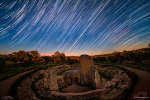 Star Trails and the Equinox Sunrise
21.03.2019
Stars trail and the Sun rises in this night and day composite panorama made on March 19. The view looks toward the eastern horizon from La Nava de Santiago, Spain. To create...
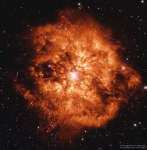 Wolf Rayet Star 124: Stellar Wind Machine
8.03.2020
Some stars explode in slow motion. Rare, massive Wolf-Rayet stars are so tumultuous and hot that they are slowly disintegrating right before our telescopes. Glowing gas globs each typically over 30 times more massive than the Earth are being expelled by violent stellar winds.
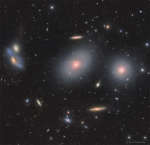 In the Heart of the Virgo Cluster
15.06.2022
The Virgo Cluster of Galaxies is the closest cluster of galaxies to our Milky Way Galaxy. The Virgo Cluster is so close that it spans more than 5 degrees on the sky - about 10 times the angle made by a full Moon.
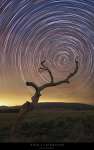 APOD: 2026 April 16 Б South Celestial Tree
16.04.2026
If you live in the northern hemisphere, you may have learned how to locate the North Star, Polaris, in the night sky. It can be used to find north, and it approximately marks the northern celestial pole.
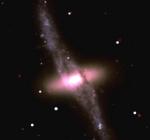 NGC 4650A: Strange Galaxy and Dark Matter
25.06.1998
This strangely distorted galaxy of stars is cataloged as NGC 4650A. It lies about 165 million light-years away in the southern constellation Centaurus. The complex system seems to have at least two parts, a flattened disk of stars with a dense, bright, central core and a sparse, sharply tilted ring of gas, dust and stars.
 Andromeda in a Single Shot
25.06.2021
How far can you see? The Andromeda Galaxy, 2.5 million light years away, is the most distant object easily seen by the unaided eye. Other denizens of the night sky, like stars, clusters, and nebulae, are typically hundreds to thousands of light-years distant.
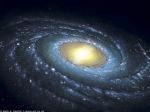 Milky Way Illustrated
4.01.2005
What does our Milky Way Galaxy look like from afar? Since we are stuck inside, and since opaque dust truncates our view in visible light, nobody knows for sure. Drawn above, however, is a good guess based on many different types of observations.
|
January February March April May June July August September |
|||||||||||||||||||||||||||||||||||||||||||||||||