
|
You entered: motion
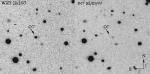 Historic Optical Flash Fades
22.04.1997
The largest telescopes in the world have scrambled to point toward this faint, fading object. Why? Because it may well be the first active optical counterpart ever found for a gamma-ray burst, and could hold the clue to the distance scale to this most enigmatic class of astronomical objects.
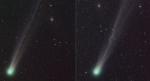 Comet C 2001 Q4 (NEAT)
23.04.2004
Inbound from the distant solar system, comet C/2001 Q4 will soon pass just inside planet Earth's orbit and should be one of two bright, naked-eye comets visible in southern skies in May. First...
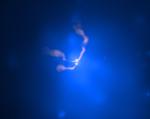 Binary Black Hole in 3C 75
12.04.2006
The two bright sources at the center of this composite x-ray (blue)/ radio (pink) image are co-orbiting supermassive black holes powering the giant radio source 3C 75. Surrounded by multimillion degree x-ray emitting gas, and blasting out jets of relativistic particles the supermassive black holes are separated by 25,000 light-years.
 Jupiter Unpeeled
6.09.2003
Slice Jupiter from pole to pole, peel back its outer layers of clouds, stretch them onto a flat surface ... and for all your trouble you'd end up with something that looks a lot like this. Scrolling right will reveal the full picture, a color mosaic of Jupiter from the Cassini spacecraft.
 Big Dipper over Pyramid Mountain
21.11.2017
When did you first learn to identify this group of stars? Although they are familiar to many people around the world, different cultures have associated this asterism with different icons and folklore. Known...
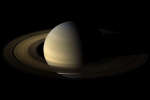 Saturn at Equinox
30.09.2009
How would Saturn look if its ring plane pointed right at the Sun? Before last month, nobody knew. Every 15 years, as seen from Earth, Saturn's rings point toward the Earth and appear to disappear.
 Full Moon, Full Mars
18.01.2025
On January 13 a Full Moon and a Full Mars were close, both bright and opposite the Sun in planet Earth's sky. In fact Mars was occulted, passing behind the Moon, when viewed from some locations in North America and northwest Africa.
 Kepler Orrery IV
5.12.2015
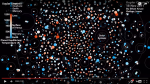
The exoplanet hunting Kepler mission's total for candidate and confirmed multiple planet systems stands at 1,705 worlds in orbit around 685 distant stars. Put all of those exoplanet orbits on the same scale and follow their relative orbital motions to get Kepler Orrery IV.
 NGC 2419: Intergalactic Wanderer
13.04.2023
Stars of the globular cluster NGC 2419 are packed into this Hubble Space Telescope field of view toward the mostly stealthy constellation Lynx. The two brighter spiky stars near the edge of the frame are within our own galaxy. NGC 2419 itself is remote though, some 300,000 light-years away.
 Alpha Cam: Runaway Star
24.11.2006
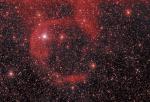
Runaway stars are massive stars traveling rapidly through interstellar space. Like a ship plowing through cosmic seas, runaway star Alpha Cam has produced this graceful arcing bow wave or bow shock - moving at over 60 kilometers per second and compressing the interstellar material in its path.
|
January February March April May June July August September |
|||||||||||||||||||||||||||||||||||||||||||||||||