
|
You entered: space
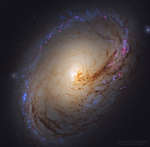 Spiral Galaxy M96 from Hubble
11.06.2019
Dust lanes seem to swirl around the core of Messier 96 in this colorful, detailed portrait of the center of a beautiful island universe. Of course M96 is a spiral galaxy, and counting...
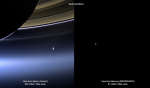 Interplanetary Earth
11.10.2019
In an interplanetary first, on July 19, 2013 Earth was photographed on the same day from two other worlds of the Solar System, innermost planet Mercury and ringed gas giant Saturn. Pictured...
 Unwinding M51
20.08.2020
The arms of a grand design spiral galaxy 60,000 light-years across are unwound in this digital transformation of the magnificent 2005 Hubble Space Telescope portrait of M51. In fact...
 Comet Leonards Tail Wag
9.01.2022
Why does Comet Leonard's tail wag? The featured time-lapse video shows the ion tail of Comet C/2021 A1 (Leonard) as it changed over ten days early last month. The video was taken by NASA's Solar Terrestrial Relations Observatory-Ahead (STEREO-A) spacecraft that co-orbits the Sun at roughly the same distance as the Earth.
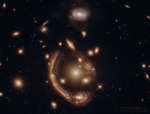 A Molten Galaxy Einstein Ring Galaxy
4.07.2022
It is difficult to hide a galaxy behind a cluster of galaxies. The closer cluster's gravity will act like a huge lens, pulling images of the distant galaxy around the sides and greatly distorting them. This is just the case observed in the featured image recently re-processed image from the Hubble Space Telescope.
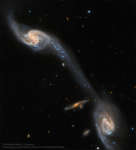 Galaxies: Wilds Triplet from Hubble
7.11.2022
How many galaxies are interacting here? This grouping of galaxies is called the Wild Triplet, not only for the discoverer, but for the number of bright galaxies that appear. It had been assumed that...
 M1: The Crab Nebula
8.11.2023
The Crab Nebula is cataloged as M1, the first object on Charles Messier's famous 18th century list of things which are not comets. In fact, the Crab is now known to be a supernova remnant, debris from the death explosion of a massive star witnessed by astronomers in the year 1054.
 A Perseid Below
8.08.2024
Denizens of planet Earth typically watch meteor showers by looking up. But this remarkable view, captured on August 13, 2011 by astronaut Ron Garan, caught a Perseid meteor by looking down. From Garan...
 APOD: 2024 August 21 Б Fermis 12 year All Sky Gamma ray Map
20.08.2024
Forget X-ray vision Б imagine what you could see with gamma-ray vision! The featured all-sky map shows what the universe looks like to NASA's Fermi Gamma-ray Space Telescope. Fermi sees light with energies about a billion times what the human eye can see, and the map combines 12 years of Fermi observations.
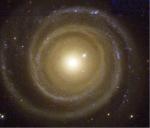 The Spiral Arms of NGC 4622
24.01.2002
While stirring a morning cup of coffee and thinking cosmic thoughts many astronomers would glance at this Hubble Space Telescope image of spiral galaxy NGC 4622 and assume that the galaxy was rotating counterclockwise in the picture.
|
January February March April May June July August September |
|||||||||||||||||||||||||||||||||||||||||||||||||