
|
You entered: space
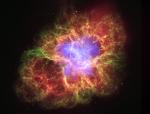 Composite Crab
26.10.2006
The Crab Nebula is cataloged as M1, the first object on Charles Messier's famous list of things which are not comets. In fact, the Crab is now known to be a supernova remnant, expanding debris from the death explosion of a massive star.
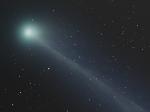 The Ghostly Tail of Comet SWAN
6.11.2006
What causes the structure in Comet SWAN's tail? Comet SWAN, which unexpectedly flared up to naked-eye brightness last week, has been showing detail in its ion tail that might be described as ghostly.
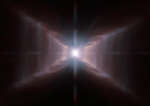 The Red Rectangle Nebula from Hubble
14.06.2010
How was the unusual Red Rectangle nebula created? At the nebula's center is a young binary star system that surely powers the nebula but does not, as yet, explain its colors. The unusual...
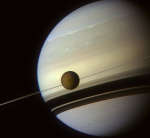 In the Shadow of Saturns Rings
3.07.2012
Humanity's robot orbiting Saturn has recorded yet another amazing view. That robot, or course, is the spacecraft Cassini, while the new amazing view includes a bright moon, thin rings, oddly broken clouds, and warped shadows. Titan, Saturn's largest moon, appears above as a featureless tan as it is continually shrouded in thick clouds.
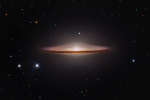 M104: The Sombrero Galaxy
4.02.2015
The striking spiral galaxy M104 is famous for its nearly edge-on profile featuring a broad ring of obscuring dust lanes. Seen in silhouette against an extensive bulge of stars, the swath of cosmic dust lends a broad brimmed hat-like appearance to the galaxy suggesting the more popular moniker, The Sombrero Galaxy.
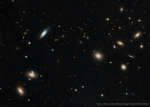 Inside the Coma Cluster of Galaxies
28.02.2015
Almost every object in the above photograph is a galaxy. The Coma Cluster of Galaxies pictured above is one of the densest clusters known - it contains thousands of galaxies. Each of these galaxies houses billions of stars - just as our own Milky Way Galaxy does.
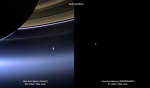 APOD: 2026 June 13 Б Interplanetary Earth
13.06.2026
In an interplanetary first, on July 19, 2013 Earth was photographed on the same day from two other worlds of the Solar System, innermost planet Mercury and ringed gas giant Saturn. Pictured...
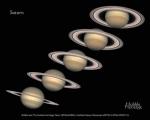 The Seasons of Saturn
5.04.2003
Since Saturn's axis is tilted as it orbits the Sun, Saturn has seasons, like those of planet Earth ... but Saturn's seasons last for over seven years. So what season is it on Saturn now? Orbiting the equator, the tilt of the rings of Saturn provides quite a graphic seasonal display.
 Twistin' by the Lagoon
23.01.1997
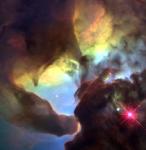
The awesome spectacle of starbirth produces extreme stellar winds and intense energetic starlight -- bombarding dusty molecular clouds inside the Lagoon Nebula (M8). At least two long funnel shaped clouds, each roughly half a light-year long, have apparently been formed by this activity.
 Historic Optical Flash Fades
22.04.1997
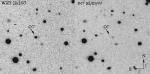
The largest telescopes in the world have scrambled to point toward this faint, fading object. Why? Because it may well be the first active optical counterpart ever found for a gamma-ray burst, and could hold the clue to the distance scale to this most enigmatic class of astronomical objects.
|
January February March April May June July August September |
|||||||||||||||||||||||||||||||||||||||||||||||||