
|
You entered: space
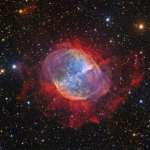 M27 Not a Comet
8.06.2017
While hunting for comets in the skies above 18th century France, astronomer Charles Messier diligently kept a list of the things he encountered that were definitely not comets. This is number 27 on his now famous not-a-comet list.
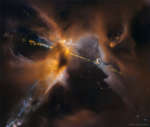 Duel Particle Beams in Herbig Haro 24
10.03.2018
This might look like a double-bladed lightsaber, but these two cosmic jets actually beam outward from a newborn star in a galaxy near you. Constructed from Hubble Space Telescope image data, the stunning scene...
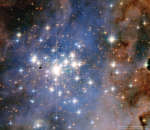 Young Star Cluster Trumpler 14 from Hubble
13.05.2019
Why does star cluster Trumpler 14 have so many bright stars? Because it is so young. Many cluster stars have formed only in the past 5 million years and are so hot they emit detectable X-rays.
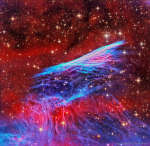 The Pencil Nebula Supernova Shock Wave
13.04.2021
This supernova shock wave plows through interstellar space at over 500,000 kilometers per hour. Near the middle and moving up in this sharply detailed color composite, thin, bright, braided filaments are actually long ripples in a cosmic sheet of glowing gas seen almost edge-on.
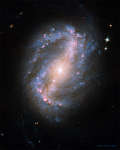 Barred Spiral Galaxy NGC 6217
20.02.2022
Many spiral galaxies have bars across their centers. Even our own Milky Way Galaxy is thought to have a modest central bar. Prominently barred spiral galaxy NGC 6217, featured here, was captured in spectacular detail in this image taken by the Advanced Camera for Surveys on the orbiting Hubble Space Telescope in 2009.
 Interplanetary Earth
22.11.2024
In an interplanetary first, on July 19, 2013 Earth was photographed on the same day from two other worlds of the Solar System, innermost planet Mercury and ringed gas giant Saturn. Pictured...
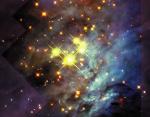 The Brown Dwarfs of Orions Trapezium
30.08.2000
The bright stars above are well known as heart of the Trapezium, an open cluster of stars in the center of the Orion Nebula. The many dim objects, however, are not well known, and have come to attention only on recent images in infrared light.
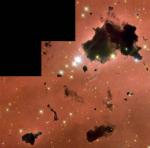 Thackeray's Globules
7.01.2002
Rich star fields and glowing hydrogen gas silhouette dense, opaque clouds of interstellar gas and dust in this Hubble Space Telescope close-up of IC 2944, a bright star forming region in Centaurus, 5,900 light-years away. The largest of these dark globules, first spotted by South African astronomer A. D.
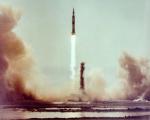 Happy Birthday Jules Verne
14.02.2003
One hundred seventy-five years ago (on February 8th), Jules Verne was born in Nantes, France. Inspired by a lifelong fascination with machines, Verne wrote visionary works about "Extraordinary Voyages" including such terrestrial travels as Around the World in 80 Days, Journey to the Centre of the Earth, and Twenty Thousand Leagues Under the Sea.
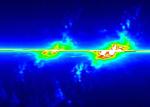 Streaming From A Black Hole
13.06.1997
Glowing gas clouds are streaming from the core of galaxy NGC4151 at hundreds of thousands of miles per hour. A powerful tool, the Hubble Space Telescope's new STIS instrument, makes it possible to map out the cloud velocities - producing this false color "velocity map" for the central regions of NGC4151.
|
January February March April May June July August September |
|||||||||||||||||||||||||||||||||||||||||||||||||