
|
You entered: space
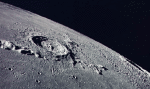 The Barren Moon
3.01.1998
The above photo, taken as the Apollo 17 astronauts orbited the Moon in 1972, depicts the stark lunar surface around the Eratosthenes and Copernicus craters. Many similar images of a Moon devoid of life are familiar to denizens of the space age.
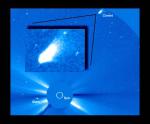 Discovery Image: Comet SOHO (1998 J1)
20.05.1998
Staring at the Sun from a vantage point in space (Kids, don't try this at home!), the Solar and Heliospheric Observatory (SOHO) has enabled the discovery of much about our closest star. It has also been used to discover about 50 comets.
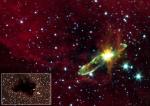 Young Star, Dark Cloud
26.12.2003
High-speed outflows of molecular gas from a young stellar object glow in infrared light, revealing themselves in this recent false-color image from the Spitzer Space Telescope. Cataloged as HH (Herbig-Haro) 46/47 the infrared source...
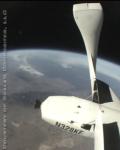 Planet Earth from SpaceShipOne
25.06.2004
On June 21st, pilot Mike Melvill made a historic flight in the winged craft dubbed SpaceShipOne -- the first private manned mission to space. The spaceship reached an altitude of just over 62 miles (100 kilometers) on a suborbital trajectory, similar to the early spaceflights in NASA's Mercury Program. So, how was the view?
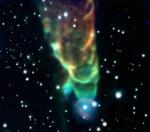 Cosmic Tornado HH 49 50
11.08.2007
Light-years in length, this cosmic tornado is actually a powerful jet cataloged as HH (Herbig-Haro) 49/50 blasting down from the top of a Spitzer Space Telescope view. Though such energetic outflows are well known...
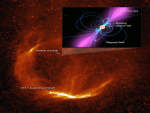 A Dark Pulsar in CTA 1
21.10.2008
Where's the pulsar? Previously, the nebula CTA 1 showed an expanding supernova remnant, a jet, and a point source expected to be a pulsar -- a rotating neutron star producing pulses at radio energies. But no radio pulses were detected.
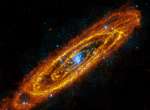 The Once and Future Stars of Andromeda
20.01.2011
The big, beautiful Andromeda Galaxy, aka M31, is a spiral galaxy a mere 2.5 million light-years away. Two space-based observatories have combined to produce this intriguing composite image of Andromeda, at wavelengths outside the visible spectrum. The remarkable view follows the locations of this galaxy's once and future stars.
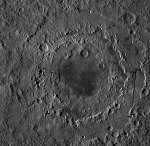 Mare Orientale
12.03.2011
Shaped like a target ring bull's-eye, the Mare Orientale is one of the most striking large scale lunar features. Located on the Moon's extreme western edge, it is unfortunately difficult to see from an earthbound perspective.
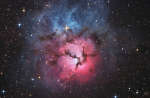 A Beautiful Trifid
20.10.2017
The beautiful Trifid Nebula is a cosmic study in contrasts. Also known as M20, it lies about 5,000 light-years away toward the nebula rich constellation Sagittarius. A star forming region in the plane...
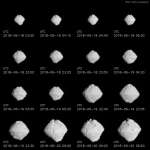 Hayabusa2 Approaches Asteroid Ryugu
25.06.2018
It looks like a big space diamond -- but with craters. It's 162173 Ryugu (Dragon's Castle), and Japan's robotic Hayabusa2 mission is now arriving at this near-Earth asteroid. Ambitious Hayabusa2 is carrying...
|
January February March April May June July August September |
|||||||||||||||||||||||||||||||||||||||||||||||||