
|
You entered: Sun
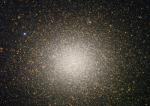 NGC 5139: Omega Centauri
19.04.2007
Centaurus is one of the most striking constellations in the southern sky. The Milky Way flows through this celestial expanse whose wonders also include the closest star system to the Sun, Alpha Centauri, and the largest globular star cluster in our galaxy, Omega Centauri (aka NGC 5139).
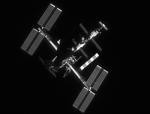 A Visit from Atlantis
28.06.2007
This remarkable image of the space shuttle orbiter Atlantis docked with the International Space Station (ISS) was taken at a range of 190 nautical miles. To record the fast moving pair, last week astronomers...
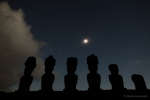 Easter Island Eclipse
14.07.2010
Makemake, a god in Easter Island mythology, may have smiled for a moment as clouds parted long enough to reveal this glimpse of July 11's total solar eclipse to skygazers. In the foreground...
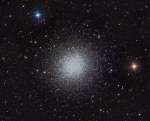 M13: The Great Globular Cluster in Hercules
14.06.2012
In 1716, English astronomer Edmond Halley noted, "This is but a little Patch, but it shews itself to the naked Eye, when the Sky is serene and the Moon absent." Of course, M13 is now modestly recognized as the Great Globular Cluster in Hercules, one of the brightest globular star clusters in the northern sky.
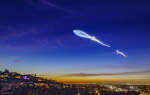 SpaceX Rocket Launch Plume over California
24.12.2017
What's happened to the sky? On Friday, the photogenic launch plume from a SpaceX rocket launch created quite a spectacle over parts of southern California and Arizona. Looking at times like a giant...
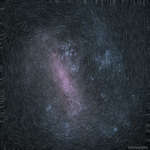 Rotation of the Large Magellanic Cloud
16.05.2018
This image is not blurry. It shows in clear detail that the largest satellite galaxy to our Milky Way, the Large Cloud of Magellan (LMC), rotates. First determined with Hubble, the rotation of the LMC is presented here with fine data from the Sun-orbiting Gaia satellite.
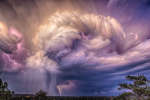 Lightning over Colorado
27.09.2020
Have you ever watched a lightning storm in awe? Join the crowd. Oddly, details about how lightning is produced remains a topic of research. What is known is that updrafts carry light ice crystals into collisions with larger and softer ice balls, causing the smaller crystals to become positively charged.
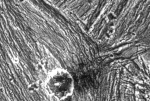 Ganymede: A Really Groovy Moon
11.07.1996
Ganymede's surface is a wrinkled mess. As large ice-sheets shift on the moon's surface, parts of the surface buckle causing high ridges, deep furrows, and parallel grooves. This photo, taken by the Galileo spacecraft currently orbiting Jupiter, was released yesterday. The large circular feature near the picture bottom is a large impact crater.
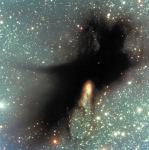 BHR 71: Stars, Clouds, and Jets
27.01.2003
What is happening to molecular cloud BHR 71? Quite possible, a binary star system is forming inside. Most stars in our Galaxy are part of binary star systems, but few have ever been seen in formation.
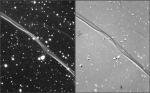 SN 1006: Historys Brightest Supernova
17.03.2003
Suddenly, in the year 1006 AD, a new star appeared in the sky. Over the course of just a few days, the rogue star became brighter than the planet Venus. The star, likely...
|
January February |
|||||||||||||||||||||||||||||||||||||||||||||||||