
|
You entered: Sun
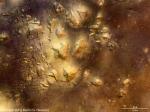 APOD: 2006 September 26- Mars Express: Return to Cydonia
26.09.2006
The unusual stone mesas of the Cydonia region on Mars are quite striking in appearance. Last week, the Mars Express project released a new close-up image of a portion of the Cydonia region on Mars. This new image, taken by the robotic Mars Express spacecraft now orbiting Mars, shows an area about 90 kilometers wide.
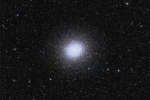 Omega Centauri: The Largest Globular Cluster Known
1.03.2009
This huge ball of stars predates our Sun. Long before humankind evolved, before dinosaurs roamed, and even before our Earth existed, ancient globs of stars condensed and orbited a young Milky Way Galaxy. Of the 200 or so globular clusters that survive today, Omega Centauri is the largest, containing over ten million stars.
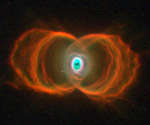 MyCn18: An Hourglass Planetary Nebula
7.08.2011
The sands of time are running out for the central star of this hourglass-shaped planetary nebula. With its nuclear fuel exhausted, this brief, spectacular, closing phase of a Sun-like star's life occurs as its outer layers are ejected - its core becoming a cooling, fading white dwarf.
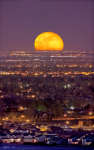 Full Moonrise
5.05.2012
Rising as the Sun sets, tonight's Full Moon could be hard to miss. Remarkably, its exact full phase (May 6 03:36 UT) will occur less than two minutes after it reaches perigee, the closest point to Earth in the Moon's orbit, making it the largest Full Moon of 2012.
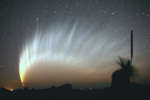 The Magnificent Tail of Comet McNaught
17.11.2013
Comet McNaught, the Great Comet of 2007, grew a spectacularly long and filamentary tail. The magnificent tail spread across the sky and was visible for several days to Southern Hemisphere observers just after sunset. The amazing tail showed its greatest extent on long-duration, wide-angle camera exposures.
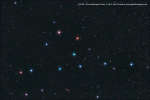 Collinder 399: The Coat Hanger
26.08.2015
Is this coat hanger a star cluster or an asterism? This cosmic hang-up has been debated over much of last century, as astronomers wondered whether this binocular-visible object is really a physically associated open cluster or a chance projection. Chance star projections are known as asterisms, an example of which is the popular Big Dipper.
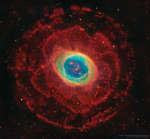 Rings Around the Ring Nebula
15.07.2018
There is much more to the familiar Ring Nebula (M57), however, than can be seen through a small telescope. The easily visible central ring is about one light-year across, but this remarkably deep exposure...
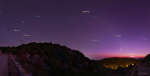 APOD: 2023 January 2 Б After Sunset Planet Parade
2.01.2023
Look up tonight and see a whole bunch of planets. Just after sunset, looking west, planets Venus, Saturn, Jupiter and Mars will all be simultaneously visible. Listed west to east, this planetary lineup will have Venus nearest the horizon, but setting shortly after the Sun.
 Comet at Moonrise
4.10.2024
Comet C/2023 A3 (TsuchinshanБATLAS) is growing brighter in planet Earth's sky. Fondly known as comet A3, this new visitor to the inner Solar System is traveling from the distant Oort cloud. The comet...
 Eros Horizon View
25.05.2000
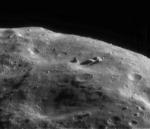
Since April 30, the robotic NEAR-Shoemaker spacecraft has been orbiting only 31 miles from asteroid Eros. Cruising over the asteroid's north and south poles at a leisurely 7 miles per hour, the spacecraft completes an orbit once every 1.2 earth days. This dramatic horizon view
|
January February |
|||||||||||||||||||||||||||||||||||||||||||||||||