
|
You entered: time
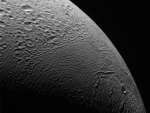 Thirty Thousand Kilometers Above Enceladus
17.03.2008
What does the surface of Saturn's ice-spewing moon Enceladus look like? To help find out, the robotic Cassini spacecraft now orbiting Saturn was sent soaring past the cryovolcanic moon and even right through one of Enceladus' ice plumes. Cassini closed to about 52 kilometers during its closest encounter to date.
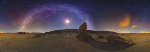 The Milky Way Over Tenerife
5.04.2011
Have you ever seen the band of our Milky Way Galaxy? Chances are you have never seen it like this -- nor could you. In a clear sky from a dark location at the right time, a faint band of light is visible across the sky. This band is the disk of our spiral galaxy.
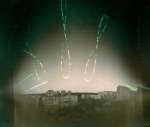 Solargraphy Analemmas
20.03.2014
Today is the equinox. The Sun crosses the celestial equator heading north at 16:57 UT, marking the northern hemisphere's first day of spring. To celebrate, consider this remarkable image following the Sun's yearly trek through planet Earth's sky, the first analemmas exposed every day through the technique of solargraphy.
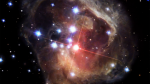 V838 Light Echo: The Movie
17.06.2014
What caused this outburst of V838 Mon? For reasons unknown, star V838 Mon suddenly became one of the brightest stars in the entire Milky Way Galaxy. Then, just a few months later, it faded.
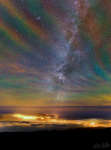 Rainbow Airglow over the Azores
22.03.2016
Why would the sky glow like a giant repeating rainbow? Airglow. Now air glows all of the time, but it is usually hard to see. A disturbance however -- like an approaching storm -- may cause noticeable rippling in the Earth's atmosphere.
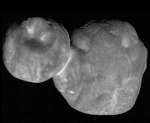 Sharpest Ultima Thule
28.02.2019
On January 1, New Horizons swooped to within 3,500 kilometers of the Kuiper Belt world known as Ultima Thule. That's about 3 times closer than its July 2015 closest approach to Pluto.
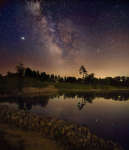 The Milky Way Over Ontario
29.07.2008
Sometimes, after your eyes adapt to the dark, a spectacular sky appears. Such was the case earlier this month over Ontario, Canada, when part of a spectacular sky also became visible in a reflection off a lake.
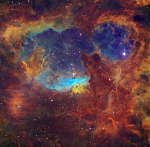 Massive Stars in NGC 6357
5.02.2016
Massive stars lie within NGC 6357, an expansive emission nebula complex some 6,500 light-years away toward the tail of the constellation Scorpius. In fact, positioned near center in this ground-based close-up...
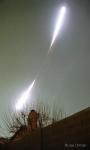 Eclipse Moon Trail
13.10.2000
Tonight, Friday the 13th, October's big, bright, beautiful full Moon will be in the sky, rising as the sun sets. A time exposure of this evening's full Moon would show a brilliant circular arc or Moon trail tracing its celestial path.
 Powers of Ten
1.02.2011
How different does the universe look on small, medium, and large scales? The most famous short science film of its generation gives breathtaking comparisons. That film, Powers of Ten, originally created in the 1960s, has now been officially posted to YouTube and embedded above.
|
January February March April May June July August September |
|||||||||||||||||||||||||||||||||||||||||||||||||